Tank Rust Removal: Inside, Outside and When to Call a Pro
Tank rust comes in two forms, and each needs a different fix. Rust inside a fuel tank is a chemistry and cleanout job. Rust on the outside of a steel tank, its shell, legs, skids, brackets and the equipment around it, is a surface-preparation job, and that is where our mobile dustless blasting service fits. In the Bay Area, we blast rust from steel starting at $3 per sq ft, with free estimates. Below we explain how to tell the two apart, how to judge severity, what each fix involves and when a tank is past saving.
TL;DR
- Rust forms when steel meets moisture and oxygen. Tanks left unused or kept near empty collect condensation and rust from the inside out.
- Judge severity first: light (small patches), moderate (corrosion over larger areas) or heavy (thick, flaky rust over most of the tank). Heavy rust with holes means replacement, not cleaning.
- Rust on a tank’s exterior and on the steel around it is best removed by wet abrasive blasting, then coated right away. We do this on site, starting at $3 per sq ft.
- Fuel, rinse water and acid waste are hazardous. Never pour them down a drain or onto the ground.
Table of Contents
- Inside rust or outside rust: which problem do you have?
- What causes rust in a tank
- How to judge severity
- Removing rust from inside a fuel tank
- When a tank is too far gone
- Rust on tank exteriors and equipment: blast it clean
- Who this is for
- Get your tank exterior prepped
- FAQ
- Sources
Inside rust or outside rust: which problem do you have?
The phrase “tank rust removal” covers several jobs. Sort yours before you spend money.
Inside a vehicle or equipment fuel tank. The symptoms are power loss, a filter that clogs quickly, hard starting and rust particles in drained fuel. This is a fuel-system problem. It is handled by draining, de-rusting and sealing, or by replacing the tank.
Outside a steel tank. Think of storage tanks, water tanks, air receivers, trailer and truck tanks, hoppers and their supports. Here rust is flaking paint, orange scale and pitting on the surface. It threatens the coating and, over time, the wall thickness. This is a blasting and recoating job.

Both. A tank that has been sitting often rusts inside and out. Treat the outside on its own schedule: it does not depend on what you decide about the inside.
We work on the second kind. The rest of this guide covers the first kind in enough depth that you can judge it, and then goes into the second in detail, because that is where a property manager, contractor or plant manager gets the most from a professional crew.
What causes rust in a tank
Rust forms when metal meets moisture and oxygen. According to AutoZone’s fuel tank guide, a tank that sits unused or runs near empty lets condensation build, and moist air drawn in as temperatures change oxidizes the steel, which then corrodes deeper over time.
Bulk storage works the same way. The Transportation Energy Institute’s diesel storage guide explains that carbon steel in tanks and pipes forms iron oxides when exposed to water. Water settles at the bottom because it is heavier than the fuel, so the lowest part of the tank corrodes first.
On the outside, the cause is simpler: a failed coating. Bay Area fog, salt air near the bay and coast, and repeated wet-dry cycles break down paint, and bare steel rusts within weeks.
How to judge severity
Inspect before you choose a method. Shine a flashlight or use a borescope (a small camera on a flexible probe) through the filler opening and sort what you see into three levels, as AutoZone describes them:
| Level | What you see | Usual outcome |
|---|---|---|
| Light | Small patches of surface rust | Cleanable |
| Moderate | Noticeable corrosion over larger areas | Cleanable, usually with a stronger process |
| Heavy | Thick, flaky rust over most of the tank | Often replacement |
Two more checks help:
- Sample from the bottom. West Central Fuel Systems’ moisture guidance says to pull the sample from the tank bottom, not the nozzle, because nozzle fuel is already filtered. Hazy fuel points to water, and particles may be rust, dirt or pollen.
- Watch the filter. If a new filter clogs soon after refueling, sludge or rust is being stirred up from the tank bottom.
Why this matters: Heavy Duty Trucking reported that mechanics at an Atlanta dealership traced more than half of a run of low-power complaints on Ford F-250 to F-750 trucks to tank rust. And the Transportation Energy Institute notes that modern high-pressure common-rail injection systems have metal-to-metal clearances too tight to tolerate corrosion particles. Even a little rust can hurt a modern engine.
Removing rust from inside a fuel tank
Inside the tank, the common approaches are acid soaks and commercial rust removers. Each one trades speed against risk to the metal.
- White vinegar. J.D. Power calls it the safest home acid: slow, inexpensive and the least likely to damage the metal. Expect a soak of several hours to overnight, with periodic agitation using steel BBs or small nuts and bolts. AutoZone suggests 12 to 24 hours and says vinegar often takes several treatments.
- Phosphoric acid and diluted muriatic acid. These work faster, in some cases in as little as 15 minutes, but they require protective equipment and can damage the metal if left too long, per J.D. Power. A phosphoric treatment leaves a thin iron-phosphate layer that resists rust, according to one restoration wiki, while muriatic acid leaves bare metal that flash-rusts quickly and needs coating fast.
- Commercial rust dissolvers. These are soaked for several hours to overnight, with frequent rotation.
- Washing, rinsing and drying. After the acid, the tank is neutralized, rinsed and dried completely. Moisture left behind restarts the rust.
The soak is not the end. Per Eastwood’s step-by-step, light flash rust after an acid rinse is normal, and a tank sealer is applied once the tank is prepared. The coating must be force-dried with low-pressure air, and the tank should be dry within 48 hours at 60°F or warmer.
Light surface rust is the realistic target for these methods. Ferber Painting reports that homemade soaks reach only very light rust and take days, and that shaking chains or bolts in a tank removes flakes but leaves corrosion that can return within months. If you see moderate or heavy rust, plan for a full process with sealing, or for replacement.
Safety when you drain and flush
Fuel work has real hazards, and these rules apply to every method:
- Work outdoors or in a well-ventilated area. J.D. Power warns that de-rusting agents produce strong odors that can cause nausea or headaches.
- Never use undiluted muriatic acid. Wear heavy rubber gloves and eye protection.
- Keep ignition sources away. One mechanic’s guide advises at least 50 feet, a Class B fire extinguisher within reach, and a disconnected negative battery terminal. Gasoline vapors are heavier than air and settle in low spots such as drains.
- Penetrating sprays are flammable. The WD-40 Specialist safety data sheet classes that product as an extremely flammable aerosol that may explode if heated. It is a release spray, not a tank cleaner, so keep it away from open fuel tanks and vapors.
Disposal
Old gasoline, acid and rinse water are household hazardous waste. The Wisconsin DNR guide lists gasoline among the items to take to a collection facility and says to keep it sealed in its original container. In California, collection runs through local programs. For example, Los Angeles S.A.F.E. Centers accept petroleum-based fuels, and they will not return gasoline or diesel containers. In the Bay Area, check your county’s household hazardous waste program.
Industrial facilities have a heavier burden. CTI-SSI explains that liquids with a flash point below 140°F are classed as D001 ignitable waste, and acid or alkaline cleaners at pH 2 or below, or 12.5 or above, as D002 corrosive waste. Disposal calls for classification, an EPA generator ID, licensed transporters, manifests and approved labeled containers.
When a tank is too far gone
Cleaning only works on metal that is still sound. Plasticautotank.com notes that repair makes sense only for superficial rust with no through-holes or soft spots, and with solid walls, seams and mounting points. Replace the tank when the metal is perforated, seams or mounting ears are badly corroded, or repeated cleanings still shed rust. Chemical removal does not suit deep pitting or heavily thinned steel. The same applies to fixed storage tanks: when the wall is thin, rust removal is not the answer. A tank inspector or engineer decides that.
Aluminum tanks corrode too, though more slowly.
Rust on tank exteriors and equipment: blast it clean
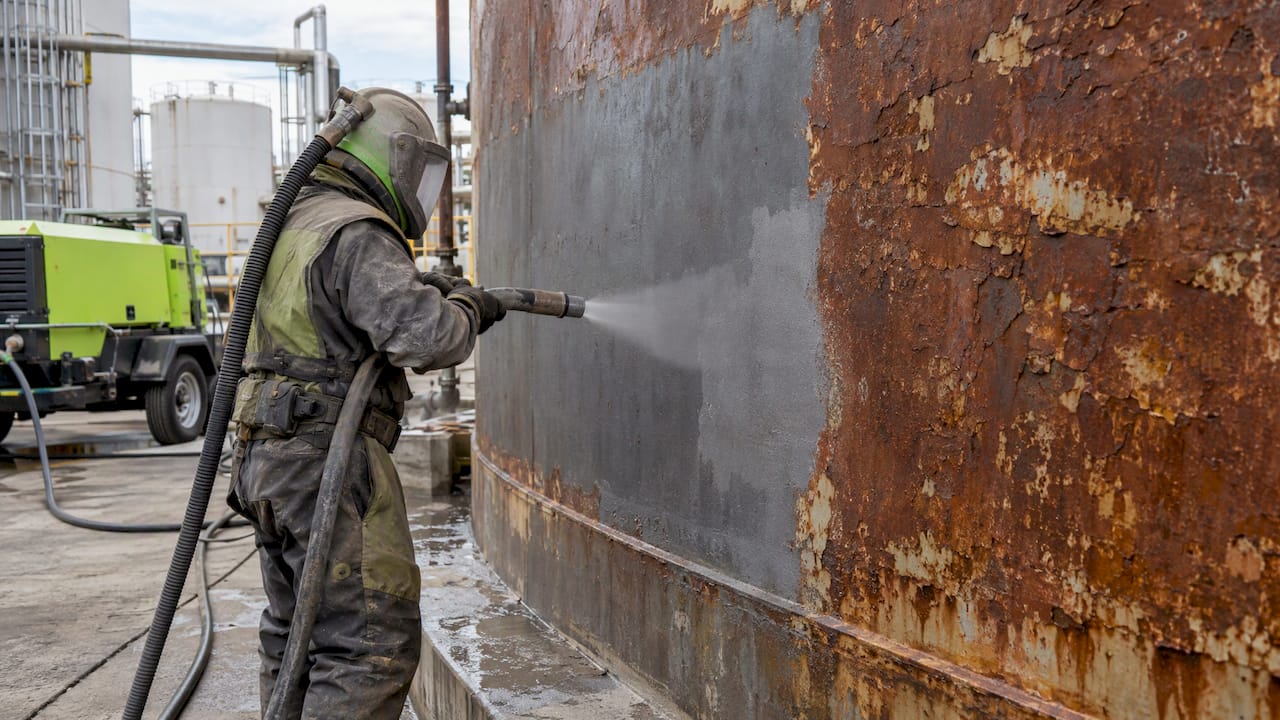
For the outside of steel tanks, the goal is a clean, uniformly profiled steel surface that a coating will bond to. Rust left under paint keeps growing and lifts the new coating. That is why prep is the step that decides how long the finish lasts.
We remove rust with dustless blasting, a wet abrasive process. Water is mixed with the abrasive at the nozzle, which produces up to 92% less dust than traditional dry sandblasting. That matters on occupied sites, near neighbors and around equipment you cannot shut down for long.
Our rigs are self-contained, carrying their own air and power. All we need is parking and access to the surface, so we can work in a yard, on a roof pad, in a mechanical enclosure or beside a loading dock without a utility hookup. For how the methods compare, see our guide on dustless blasting vs. sandblasting vs. pressure washing. For methods by rust depth, see our steel rust removal guide, and for rules and cost in this state, rust removal blasting in California.
What it costs
Our published starting rates are per square foot:
| Service | Starting rate |
|---|---|
| Rust & Metal Blasting | from $3 per sq ft |
| Dustless Blasting | from $3 per sq ft |
| Paint Removal | from $3 per sq ft |
| Surface Preparation to coating spec | $2-3 per sq ft |
A worked example: 200 sq ft of tank shell and supports at the starting rate of $3 per sq ft works out to $600. Your final figure depends on rust depth, access, the coating being removed and the finish you need, so we quote after seeing the site. Estimates are free, and you can read more in our dustless blasting cost guide.
The process, step by step
- Walk the tank and note the condition. Check rust depth, coating type and any pitting. Also look at seams, welds and mounting points. If the wall looks thin, get the structure assessed before cosmetic work.
- Define the finish. Say what coating is going on and what surface standard it requires. Coating makers publish a required cleanliness and profile. We prepare surfaces to coating spec, so tell us the product and we work to it.
- Prepare the site. The tank must be empty, clean of residue and safe to work around. Cover or move anything that should not get wet. Our rigs need only parking and access.
- Blast. Wet abrasive strips rust and old paint down to clean steel. Flash rust, a light orange haze, can appear quickly on bare steel, so the schedule matters.
- Coat promptly. Bare steel is most vulnerable right after blasting. Have the primer ready and book the coating crew for the same window. For prep that feeds into powder coating, see our powder coating prep service.
- Dispose of waste properly. Spent abrasive and removed coatings go according to local rules. Old paint may contain lead. If it does, the work is a lead job with containment, which we handle under lead paint removal.
On tank exteriors, we recommend a coating plan before blasting, not after. Planning the prep and the primer as one job is what keeps the rust from returning. The principles of surface preparation before coating apply on any steel, and the same logic applies when you need to protect a tank after rust removal: material and coating choices decide how long it lasts.
Who this is for
- Property managers with rusted tanks, rooftop equipment, fences, railings and steel stairs, where dust and noise complaints matter.
- Contractors who need steel prepared to a coating specification before they apply the system.
- Industrial facilities that need equipment and tank exteriors cleaned and returned to service. See industrial equipment cleaning.
- Homeowners with rusted steel tanks, trailers, gates or structural steel on their property.
Our view on tank rust
We see tank rust as a prep problem first. Whether the job is a shell, a skid or the steel around it, a coating only lasts as long as the surface under it is clean, so the blasting is where the result is decided.
That is why we built our service around mobile, self-contained rigs. We bring our own air and power, so a tank in a yard or on a rooftop can be prepped without waiting on hookups. Our wet abrasive method produces up to 92% less dust than traditional dry sandblasting, which keeps working sites cleaner.
We publish starting prices, $3 per sq ft for rust and metal blasting and $2-3 per sq ft for surface preparation, because we think you should know the range before you call. And we offer free estimates and quick scheduling, so you can plan the coating crew around us.
USA
Get your tank exterior prepped
If your tank, its supports or the steel around it show rust, tell us the size, the location and what coating you plan to apply. We will give you a free estimate and schedule a site visit. Rust and metal blasting starts at $3 per sq ft.

See our rust removal and steel blasting service, browse all services, or visit our home page to request an estimate.
FAQ
Does vinegar dissolve rust in a gas tank?
Yes, on light rust. White vinegar is a weak acid, so it works slowly: AutoZone suggests a 12 to 24 hour soak with periodic agitation, and it often takes several treatments. Heavier rust usually needs a stronger process or tank replacement.
Does WD-40 remove rust from a tank?
WD-40 Specialist Rust Release is a penetrating spray for loosening rusted parts, not a tank-cleaning treatment. Its safety data sheet classes it as an extremely flammable aerosol, so keep it away from fuel vapors.
How do I know if my tank is too rusty to clean?
Look for holes, soft spots, heavy flaking and corroded seams or mounting points. Plasticautotank.com says replacement is the better choice when the metal is perforated or repeated cleanings still shed rust.
Can you blast rust off the outside of a steel tank?
Yes. We remove rust and old coatings from steel with mobile dustless blasting and prepare the surface to your coating spec. Rust and metal blasting starts at $3 per sq ft, and estimates are free.
Where do I take old fuel and rinse water?
To a household hazardous waste collection site, never down a drain or onto the ground. In California, your county or city runs the program. Los Angeles is one example. Businesses follow hazardous waste rules and use licensed transporters.
Sources
- How to Clean a Rusty Gas Tank, AutoZone
- Diesel Fuel Storage and Handling Guide, Transportation Energy Institute
- Pursuing a Tank Rust Mystery, Heavy Duty Trucking
- Managing Moisture in Fuel Tanks, West Central Fuel Systems
- How to Clean Rust Out of a Gas Tank, J.D. Power
- GSTwin.com Wiki, Restoration / Paint
- How to Remove Rust from a Gas Tank, Ferber Painting
- How to Reseal An Old Gas Tank, Eastwood
- Best Way to Flush out a Gas Tank, Simplysolved.blog
- WD-40 Specialist Rust Release Penetrant Spray SDS
- Household Hazardous Waste Management Guide, Wisconsin DNR
- S.A.F.E. Centers, City of Los Angeles Sanitation
- How to Dispose of Old Gas in Industrial Facilities, CTI-SSI
- How to Fix a Rusted Fuel Tank, Plasticautotank.com
- Steel Door Surface Preparation Steps
- DEF Tank Material Requirements