Metal Surface Cleaning: Choosing the Right Method for Rust, Paint and Grease
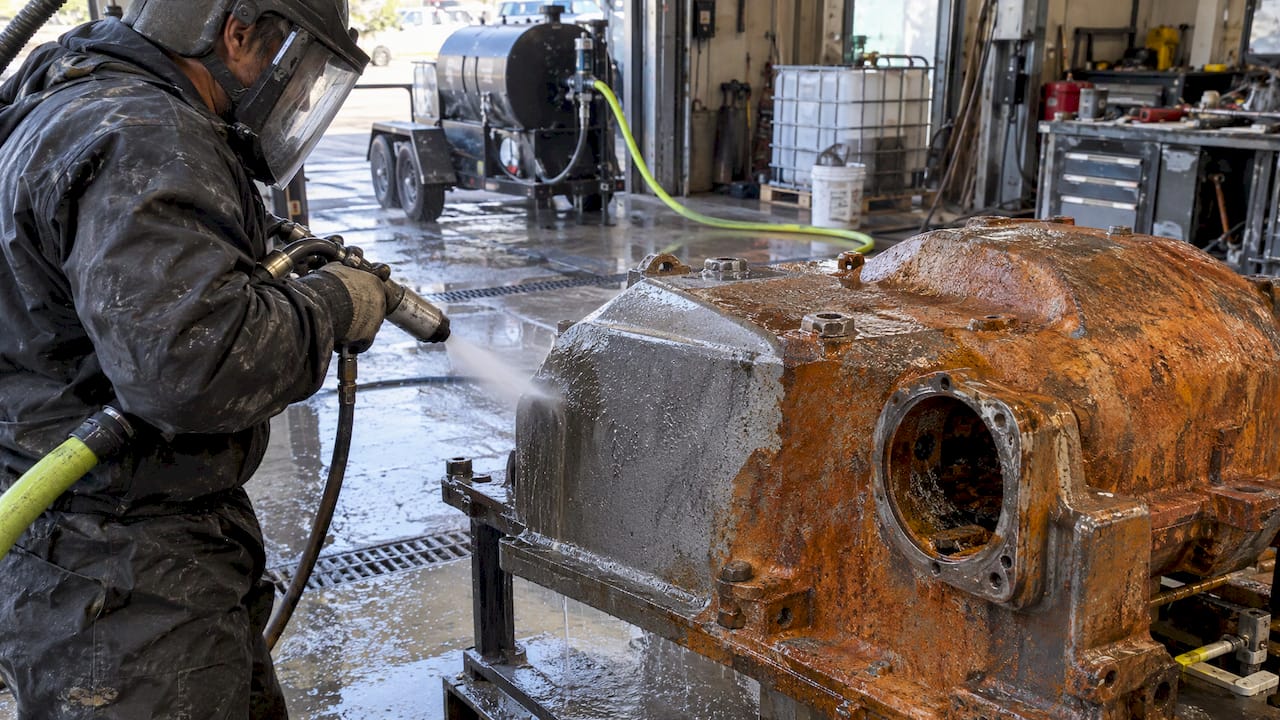
The right way to clean metal depends on what is sitting on it. Oil and grease need a cleaning agent. Rust, mill scale and old paint need abrasive removal, and that is where blasting comes in. For coating prep on steel, railings, tanks, equipment and structural metal in the Bay Area, we use dustless (wet abrasive) blasting, which cleans the surface and gives the new coating something to grip, with up to 92% less dust than traditional dry sandblasting. Rust and metal blasting starts from $3 per square foot, and estimates are free.
TL;DR
- Match the method to the contaminant: solvent or detergent for oils, abrasive blasting for rust, scale and coatings.
- Blasting does two jobs at once: it removes corrosion and creates the surface profile (anchor pattern) that a coating needs to bond.
- Wet abrasive blasting cuts dust sharply, which helps in tight, poorly ventilated spaces and around occupied buildings.
- Coat the metal promptly after cleaning, because bare steel can start to re-rust quickly in damp air.
- Our mobile rigs carry their own air and power, so on-site we need only parking and access to the surface.
Table of Contents
- What “cleaning” metal actually has to remove
- Matching the method to the contaminant
- Why blasting is the method for rust, scale and coatings
- Wet abrasive blasting: the cleaner way to blast
- What the job looks like, step by step
- Safety when metal is blasted
- Routine cleaning versus surface preparation
- Get a quote for your metal
- FAQ
- Sources
What “cleaning” metal actually has to remove
Metal gets dirty in several different ways, and each one needs a different answer. According to a pre-coating surface preparation guide, cleaning may need to remove oil, grease, soil, cutting compounds, rust, mill scale and old coating residues. Mill scale is the hard, flaky gray oxide layer that forms on steel when it is hot rolled.
It helps to sort the problem into three groups:
- Oils and grease. Machining fluids, cooking residue, lubricants. These sit on top of the metal.
- Corrosion and scale. Rust, mill scale and other oxides. These are part of the metal’s surface layer and cannot be wiped away.
- Old coatings. Paint, powder coat, primer, epoxy or graffiti that has to come off before anything new goes on.
OSHA’s shipyard surface-preparation guidance lists the same range of jobs: removing old paint, oil, scale or rust, using methods from solvent and chemical removal to abrasive blasting, needle gunning and grinding. The point is that no single cleaner handles all three groups.
Matching the method to the contaminant
The same guide notes that solvent cleaning deals with oils and grease but does not remove rust, scale or old coating. Wiping technique matters too: it warns that sloppy solvent wiping can smear dissolved oil across the surface and leave a thin film that interferes with coating adhesion.
The ASTM guide on selecting cleaning agents and processes tells specifiers to weigh the part material, the cleanliness the next step requires, environmental and cost factors, and health and safety. It also recommends comparing total life-cycle cost rather than only the price of the first pass. That is a useful frame for a property manager or contractor comparing quotes.
| What is on the metal | What removes it | Where it falls short |
|---|---|---|
| Light oil, grease, fingerprints | Solvent or alkaline washing, then rinsing | Does not touch rust, scale or paint |
| Surface rust and mill scale | Abrasive blasting, grinding | Needs dust, debris and noise control |
| Multiple layers of paint | Abrasive blasting, chemical strippers | Chemicals are slow on thick or layered coatings |
| Coating failure on large structures | Blasting, including wet abrasive | Needs a plan for cleanup and waste |
ASM International’s classification of cleaning processes shows how many chemical and mechanical routes exist. That range is the reason matching soil to process beats reaching for one universal cleaner.
Why blasting is the method for rust, scale and coatings
If the metal will be recoated, there are generally two operations. The 2026 PCI Magazine comparison describes them as removing contaminants, rust products, oxides and mill scale, then generating a surface profile that supports coating adhesion.
Abrasive blasting does both in one operation. The same article says it is widely used in protective and marine coatings because it removes corrosion and creates a prescribed anchor pattern at once, especially on large structures that cannot be dipped in an immersion pretreatment. Immersion baths are also impractical outdoors, where water quality varies and flash rust is a risk.
That matches what we see as the reason to blast rather than wipe: a coating bonds to a clean, slightly textured surface, not to a smooth, oxidized or contaminated one. A solvent wipe leaves rust under the paint. Grinding wheels reach flat areas but struggle with welds, corners, pitting and ornamental ironwork. Blasting follows the shape of the part.
For a deeper look at corrosion by depth, see our guide to steel rust removal by rust depth, and for California specifics, rust removal blasting rules and cost.

Wet abrasive blasting: the cleaner way to blast
Traditional dry blasting throws abrasive and dust into the air. The PCI Magazine article notes that abrasive blasting generally produces substantial dust, noise and waste that need containment and specialized protective equipment.
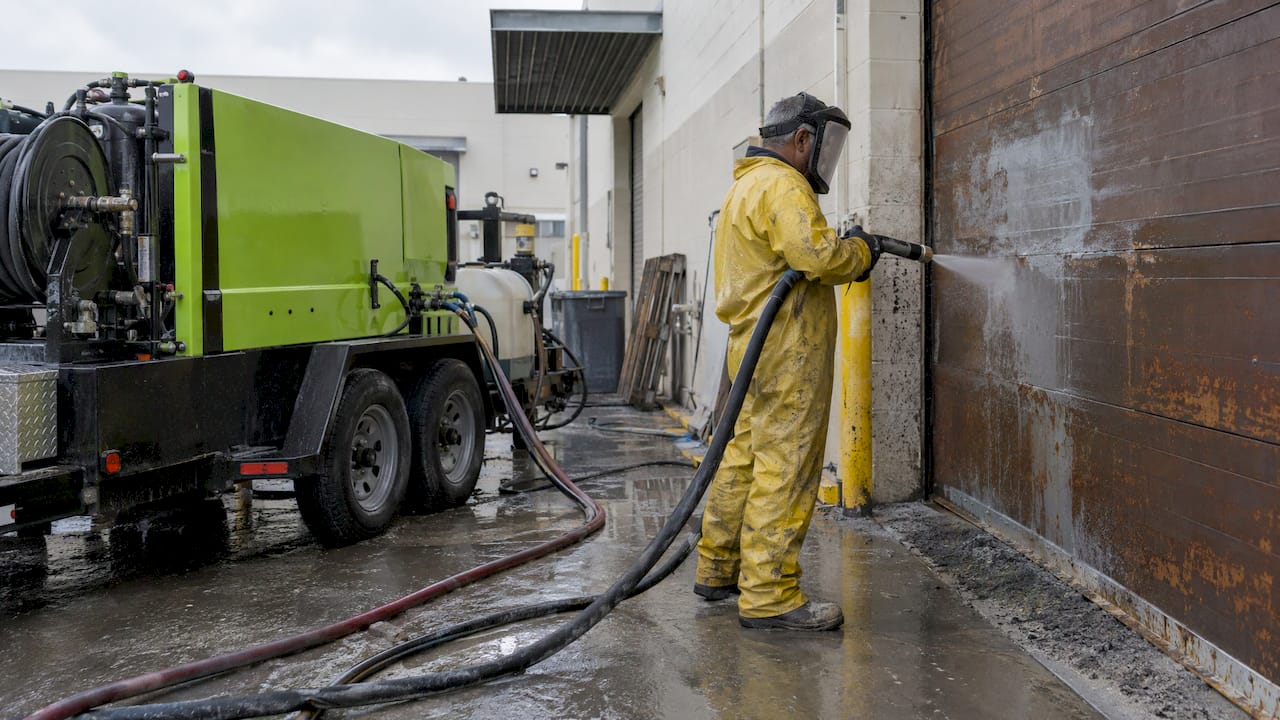
Wet abrasive blasting addresses the dust side directly. AMPP, the professional association for protective coatings, explains that wet abrasive systems create significantly less dust than dry blasting because the added water binds fine particles and weighs them down. It says this is useful in close quarters, in poorly ventilated locations and when removing coatings that contain toxic materials.
Our dustless method produces up to 92% less dust than traditional dry sandblasting. For you, that usually means:
- Work can happen near occupied units, storefronts and active equipment.
- Less airborne dust drifting onto cars, windows and neighboring properties.
- Cleanup focuses on collecting the wet residue rather than a dust cloud.
For a side-by-side with the other common options, read dustless blasting vs. sandblasting vs. pressure washing.
What the job looks like, step by step
Here is the routine for a typical metal prep job, and what each step takes.
- Identify what is on the metal. Rust, mill scale, paint, powder coat, oil. If the finish is old, tell us what you know, including the age of the coating. Lead-containing paint changes how the work is handled, so flag it early.
- Define the finish you need. The coating manufacturer’s data sheet usually states the required cleanliness and profile. Industry standards such as SSPC-SP10 (near-white metal) describe how much of the surface must be free of visible rust, paint and scale. AMPP also lists WJ-1 through WJ-4 cleanliness categories for waterjetting, from bare substrate to light cleaning. We can prepare surfaces to the coating spec you give us.
- Degrease where needed. Oil left on the surface can spread under blasting and stay as a film. Heavy oil is removed first so it is not driven into the surface.
- Blast. Our self-contained rigs carry their own air and power, so we need only parking and access to the surface. We work the surface until it meets the specified cleanliness.
- Remove residue. The National Laboratory of the Government Chemist’s coating guide says blast dust and debris should be removed before coating.
- Coat quickly. The same guide stresses that rapid re-rusting in damp conditions makes dry storage and prompt coating important after preparation. Plan the coating crew to follow the blasting crew closely, and coordinate timing with us when you book.
If your project is a larger prep package, see our surface preparation and coating prep service.
Safety when metal is blasted
Blasting has real hazards, and the method you choose decides which ones you have to control. OSHA’s guidance points out that surface preparation can involve solvents, chemical removers, flammable liquids, and mechanical blasting and grinding, each with its own risks.
The pre-coating guide lists the basics for any blasting operation:
- Never bypass the deadman control. This is the safety device that stops abrasive flow when the operator releases the nozzle grip, and it should never be wedged or tied down.
- Provide respiratory, skin, eye and hearing protection.
- Consider fire and explosion prevention, particularly around flammable materials.
For contractors and property managers, this is one more reason to hire a crew rather than assign blasting to untrained staff. Keep people and pets clear of the work zone and tell us about nearby flammables, tanks or utilities before we start.
Routine cleaning versus surface preparation
Not every metal job calls for blasting. For everyday dirt on finished metal, The Spruce calls dish soap and warm water with a soft cloth the gentlest approach, followed by rinsing and drying with microfiber. That is routine maintenance on a surface that is already in good condition.

Once the job involves rust, flaking paint, scale, graffiti or a coating that has to be replaced, you are in surface preparation territory. That is the work we do, and it is where a mobile blasting crew saves time over wheels, wire brushes and chemicals.
After the metal is prepped and primed, the finishing stage matters just as much. For interior trim and fixtures, interior painting is the final layer that determines how the work looks and lasts.
Our perspective
We prepare metal for a living, and the most common mistake we see on a coating failure is not the paint. It is the prep underneath. A coating applied over residual rust, mill scale or a greasy film is built on a weak base.
That is why we focus on wet abrasive blasting for metal. It removes the corrosion and coating, it leaves a surface ready for the next step, and it does so with up to 92% less dust than traditional dry sandblasting. Our rigs carry their own air and power, so a site does not need to supply utilities. Parking and access to the surface are enough.
We would rather you know the price before the work starts. Rust and metal blasting begins at $3 per square foot, and we offer free estimates and quick site visits so the number you plan around is a real one.
USA
Get a quote for your metal
We handle rust and metal blasting across San Francisco and the Bay Area for contractors, property managers, homeowners and industrial facilities. Typical metal jobs include railings, gates, fences, structural steel, equipment, trailers and tanks.
Rust and metal blasting is priced from $3 per square foot. General surface preparation is $2-$3 per square foot. Final price depends on the size of the job, the type and thickness of the coating, and access. For the factors behind the number, see our Bay Area dustless blasting cost breakdown.

Send us the location, the metal type and a few photos, and we will give you a free estimate. You can browse everything we do on our services page.
FAQ
What is the best way to clean rusty metal before painting?
Abrasive blasting is the method that removes rust and mill scale and creates the profile a coating needs in one operation, according to PCI Magazine. Our wet blasting does this on site with far less dust than dry sandblasting. Coat the metal promptly afterward, because bare steel can re-rust quickly in damp conditions.
Is metal surface blasting the same as sandblasting?
Both propel abrasive at the surface to remove rust, scale and coatings. Wet abrasive blasting adds water, which AMPP says binds fine particles and significantly reduces dust compared with dry blasting. Our dustless method produces up to 92% less dust than traditional dry sandblasting.
Can a solvent wipe prepare metal for a coating?
Only if the problem is oil or grease. Solvent cleaning does not remove rust, scale or old coating, and careless wiping can leave a thin oil film that interferes with adhesion. When there is corrosion or paint on the metal, blasting is the step that gets it to a coating-ready surface.
How much does metal blasting cost in the Bay Area?
Our rust and metal blasting starts from $3 per square foot, and surface preparation is $2-$3 per square foot. The final figure depends on the area, the coating or rust condition and access to the surface. We offer free estimates so you can see the number before you commit.
Do you need power or water on site?
No. Our self-contained rigs carry their own air and power. We need parking and access to the surface, which makes scheduling simpler for rooftops, yards, job sites and industrial facilities.
Sources
- Pre-Coating Surface Preparation, CED Engineering
- Surface Preparation, OSHA Shipyard Employment eTool
- Waterjet and wet abrasive blast cleaning methods, AMPP
- Surface Preparation Showdown, PCI Magazine
- ASTM D6361/D6361M Standard Guide for Selecting Cleaning Agents
- Classification and Selection of Cleaning Processes, ASM International
- Surface Preparation for Coating, National Laboratory of the Government Chemist
- How to Clean Every Type of Metal at Home, The Spruce