Brick Soot Removal: What Works and When to Call a Pro
Soot comes off brick when you match the method to the stain: a vacuum and a mild detergent for a light film on a fireplace face, and controlled wet abrasive blasting for heavy, ground-in or large-area staining on fireplaces, chimney stacks and building facades. Brick is porous, so the wrong approach pushes carbon deeper, etches the face or washes out mortar. We run mobile dustless (wet abrasive) blasting rigs across San Francisco and the Bay Area, and for anything beyond a small, light stain our brick and masonry blasting is the cleaner, faster route.
This guide is for homeowners, property managers and contractors. It covers how to size up the stain, how to prepare the brick, which gentle methods are safe, which ones to avoid, and where professional equipment earns its cost.
TL;DR
- Let the brick cool, remove loose soot first and vacuum it with a filtered vacuum. Never sweep it dry or blow it, which spreads it and grinds it in.
- Test any method on a small hidden patch first, and always start with the gentlest option.
- Avoid muriatic acid, wire brushes and high-pressure washing: they etch brick, leave metal stains and can erode mortar.
- Heavy, greasy, old or widespread soot, and soot on exterior brick, is a job for controlled wet abrasive blasting.
- We offer free estimates and quick scheduling for brick and masonry cleaning across the Bay Area.
Table of Contents
- Why soot is hard to get out of brick
- Size up the stain before you touch it
- Prepare the brick and the area
- Gentle methods for light soot
- What to avoid on brick
- Fireplace face vs. chimney and flue
- When professional wet abrasive blasting makes sense
- What it costs
- Our perspective
- Get your brick looked at
- FAQ
- Sources
Why soot is hard to get out of brick
Soot is fine carbon, often mixed with oils and tars from burning wood, oil or building materials. Brick is porous, so those particles and oils sit in the surface pores, not just on top. Wiping a dry rag across a stain mostly smears it. Cleaner applied to dry brick gets soaked up and can discolor it.
The U.S. National Park Service, in its Preservation Brief on cleaning masonry, notes that soot and smoke call for a different cleaning agent than oil or metallic stains. It also says to use the gentlest method that works, and to test methods and materials before using them. Those two rules, identify the stain and start gentle, drive everything below.
Size up the stain before you touch it
Spend ten minutes on this. It decides whether you are in a light-cleaning situation or a professional one.
| What you see | Likely situation | Sensible route |
|---|---|---|
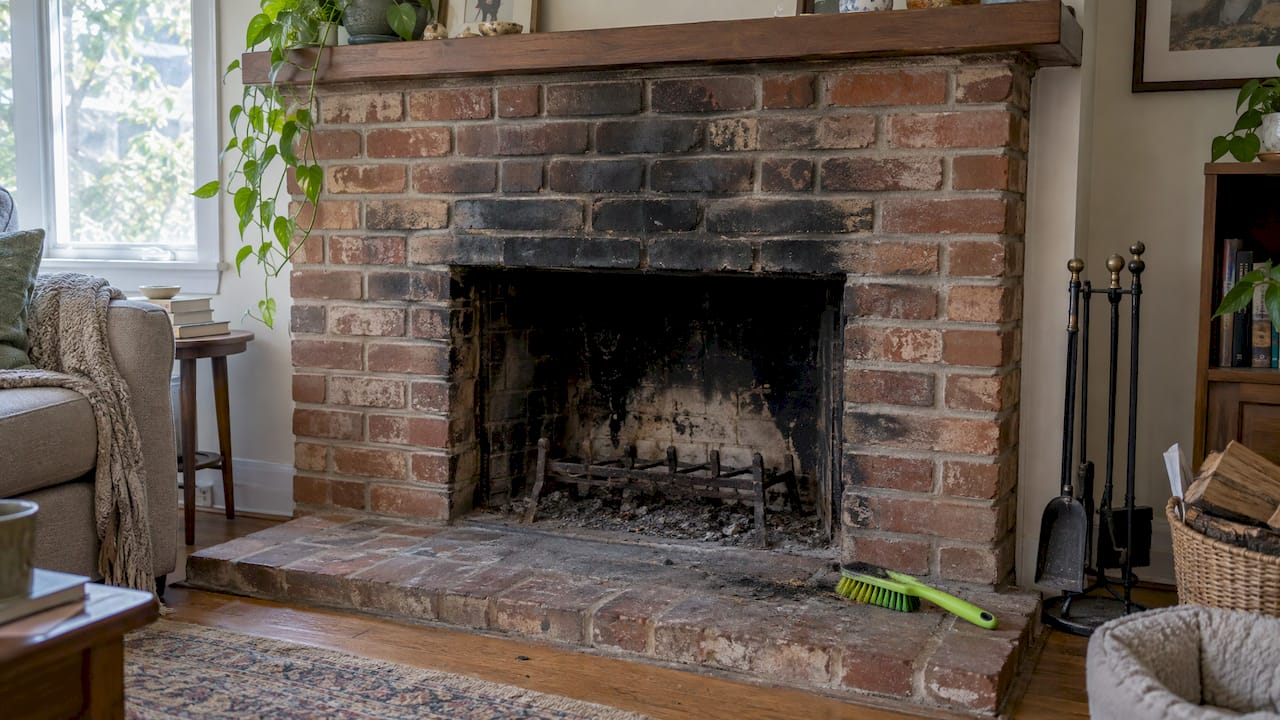
| Light gray haze on a fireplace face, dry to the touch | Surface soot from normal use | Vacuum, then mild detergent after a test patch |
| Black, greasy or shiny patches that smear | Creosote or oily residue, often years old | Specialized cleaning; blasting for the brick face |
| Dark staining on a chimney stack, exterior wall or facade | Weather-bonded soot over a large area | Controlled wet abrasive blasting |
| Soot after a structure fire, crumbling brick or loose mortar | Fire damage | Wait for clearance and a masonry evaluation first |
| Old, soft, historic or valuable brick | Fragile masonry | Professional assessment before any cleaning |
If the brick is crumbling, the mortar is loose or the building is historic, do not start scrubbing. After a structure fire, wait until the fire department has cleared the building and the chimney and masonry have been evaluated.
Prepare the brick and the area
Preparation prevents most of the damage we see people cause by cleaning too fast.
- Make sure the fireplace is cold. Prosoco’s brick fireplace guide states that firebox interiors must be cold and loose ash removed before cleaning.
- Remove loose soot with a filtered vacuum. The same guide says vacuuming with appropriate filtration lifts surface soot without grinding it deeper into the brick and protects nearby surfaces from soot migration. Do not dry sweep or blow soot off. That puts it in the air and on every surface in the room.
- Protect what is next to the brick. Cover floors, furniture, metal and wood trim with plastic sheeting and tape. Cleaners and runoff stain flooring and corrode metal.
- Wear gloves and eye protection and keep children and pets out of the room. Ventilate, and never mix cleaners.
- Wet the brick with plain water first. A masonry cleaning specification for a burnt chimney requires pre-wetting the masonry below the work area and not letting it dry before diluted cleaner goes on, because inadequate pre-wetting has been proven to cause efflorescence (the white salt deposit that shows up after drying). Pre-wetting also keeps the cleaner near the surface instead of soaking in.
- Run a test patch. The International Masonry Institute’s Masonry Restoration Cleaning Guide says whichever method you choose should be tested in a discreet but representative spot before the full cleaning, and that proprietary cleaners should be confirmed with the manufacturer. The U.S. General Services Administration’s historic masonry specification calls for test patches usually under 6 in. by 6 in. in unobtrusive locations. Wait for the patch to dry before judging it, because wet brick always looks darker.
Brick and mortar are separate materials. Mortar is softer and more porous than the brick, so it is the first thing aggressive cleaning damages. If your test patch lightens the brick but leaves the joints crumbly or sandy, stop.
Gentle methods for light soot
For a small fireplace face with a light film, mild methods are enough. Work from the mildest up, and only as far as you need.
Mild dish soap solution. This Old House recommends starting with the mildest cleanser: 1/4 cup of clear, grease-cutting dish soap in 4 cups of water, applied after saturating the bricks with plain water. Scrub top to bottom in small areas with a firm plastic-bristled brush, let it sit about 10 minutes on stubborn soot, then rinse each spot several times with clean water.

Detergent and salt. The Spruce describes a mild abrasive method for soot on brick fireplaces: 1 gallon of warm water with 2 tablespoons of grease-cutting dishwashing liquid, plain water sprayed on first, and table salt sprinkled on the brush. Wipe with a sponge, then follow with a vinegar-and-water wipe (1 cup distilled white vinegar per gallon of cool water) to remove soap residue and smoky odor.
Soaking for heavy deposits in sheltered spots. The National Park Service’s Preservation Brief notes that prolonged water misting is effective on heavy soot in rain-protected areas, but it is slow, taking several days to a week.
The National Park Service’s Keeping It Clean guide adds that superficial smoke and soot stains may be removed by gentle scrubbing with water-based household detergents that are free of acid and alkali.
Brush choice matters. Use natural or synthetic bristles, never metal. The Preservation Brief warns that metal brushes abrade brick and leave metal particles that stain.
Where these methods run out
Household cleaning works on a thin film and takes patience: dwell time, repeated scrubbing, repeated rinsing. It does not keep up with soot that has been baked in for years, soot mixed with grease, or staining over a chimney breast, a stack or a whole wall. Each scrub-and-rinse cycle also puts more water into the brick and adds time. That is the point where a mobile blasting crew saves the days.
What to avoid on brick
- Muriatic acid and strong acid washes. A restoration-industry source cautions that acid removes a microscopic layer of the brick facing, leaving it more vulnerable to moisture, and that uneven or prolonged contact causes etching and streaks. Brick that has been etched stays blotchy.
- High-pressure washing. The Preservation Brief advises starting at 100 psi or below, even garden-hose pressure, and never going above 300 to 400 psi on historic masonry. The Keeping It Clean guide warns that too much pressure can etch or scar masonry and push water through the wall.
- Metal brushes and dry sandblasting. They cut into the face of the brick and the mortar. A dry blaster also throws a cloud of dust, which is why we do not use that method.
- Oily “quick fixes.” Products that leave an oily residue can wick into unsealed brick and leave a dark patch that returns as it dries.
- Cleaner on dry brick. Always wet first.
Our comparison, dustless blasting vs. sandblasting vs. pressure washing, explains what each method removes and what it risks on different surfaces.
Fireplace face vs. chimney and flue
Cleaning the visible brick does nothing about what is building up inside the flue. Soot on the face is a cosmetic problem. Creosote inside the chimney is a fire hazard, and thick, glazed or hardened creosote needs a certified chimney sweep, not a scrub brush. If you are unsure which problem you have, read about chimney and flue maintenance separately from brick cleaning, and have the flue inspected before you light another fire. Brick cleaning and chimney sweeping are different jobs, and the second one is not something we do.

When professional wet abrasive blasting makes sense
Blasting is the right call when:
- the soot is old, heavy or oily and has not responded to a mild test patch;
- the stained brick is on an exterior wall, a chimney stack or a large fireplace wall;
- you manage a building, restaurant, warehouse or rental where downtime and mess matter;
- you are a contractor who needs brick clean before sealing, repointing, painting or restoration;
- the soot sits alongside paint, graffiti or other coatings that also need to come off.
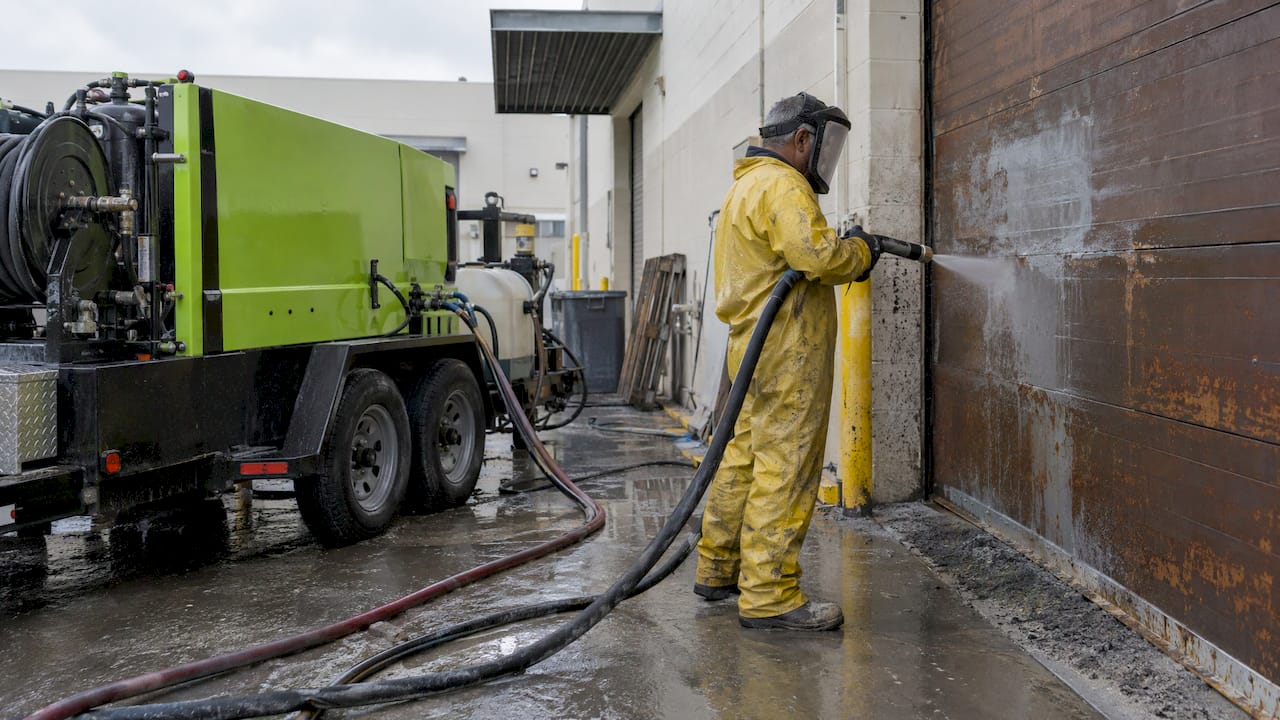
Dustless blasting mixes water with a fine abrasive in the air stream, which controls the dust. Our method produces up to 92% less dust than traditional dry sandblasting. The pressure and abrasive are set to the surface, and we start on a test area so the setting is proven on your brick before we do the rest.
Our rigs are self-contained, carrying their own air and power. All we need is parking and access to the surface, so a fireplace in a tenant space, a courtyard wall or a rooftop chimney does not need on-site utilities. Wet blasting also rinses as it cleans, so there is no multi-day soak.
What a brick-cleaning job involves
- Site visit and free estimate. We look at the brick, the mortar condition and the type of staining, and confirm access.
- Masking and protection of windows, trim, landscaping and adjacent surfaces.
- Test patch in a representative spot to set pressure and media.
- Blasting in controlled passes, brick face and joints treated with care.
- Rinse and inspection with you or your site lead.
If the brick is also painted, see removing paint from brick in San Francisco. For method and cost background, our brick cleaning services guide and masonry cleaning services guide go further.
What it costs
Our published pricing for dustless blasting starts at $3 per sq ft, quoted per project and one-off. Surface preparation is $2 to $3 per sq ft. Masonry and brick cleaning has no published rate, because soot jobs vary with the amount of staining, the height, access and the condition of the mortar, so we quote them after a look. For how pricing is built, see our dustless blasting cost guide for the Bay Area.
Our perspective
Most soot calls we get start the same way: the homeowner or manager has already tried a cleaner or two, and the brick looks patchy. Brick forgives gentle methods and punishes aggressive ones, and the difference between the two is often a few minutes of contact time or a few hundred psi.
That is why we work from the surface, not the stain. We check the brick and the mortar, match the pressure and media to what is there, and prove it on a small area first. Because our rigs run on their own air and power, we can do that on a fireplace in a tight room or on a stack three stories up without asking the building for anything but access.
Dust is the other half of it. Soot is already a mess, and dry blasting would multiply it. Wet blasting keeps up to 92% less dust in the air than dry sandblasting, which matters in occupied buildings and near neighbors.
If your soot job is bigger than a hearth, or the brick matters to you, we would rather look at it and give you a straight number than have you spend a weekend scrubbing.
USA
Get your brick looked at
If the soot is heavy, old, exterior or spread over a large area, we will visit, assess the brick and give you a free estimate, usually with quick scheduling across San Francisco and the Bay Area. Start on our services page or tell us what you are seeing.

We work for homeowners, property managers, contractors and industrial facilities, and we can quote the brick cleaning together with any related paint, graffiti or concrete work on the same visit. See our dustless blasting service page for what the work covers.
FAQ
Does Dawn dish soap remove soot from brick?
A grease-cutting dish soap diluted in water can lift a light soot film. Wet the brick first, apply with a soft brush, work in small sections and rinse several times. Test a hidden spot first. Heavy or oily soot usually needs more than soap.
Does WD-40 remove soot from brick?
We would not use it. It leaves an oily residue that unsealed brick can draw below the surface, and a dark patch can return after drying. Stay with water-based methods or have the brick professionally cleaned.
How do I clean soot off brick and mortar without damaging them?
Vacuum loose soot, wet the brick, test a small spot, and use the gentlest cleaner that works with a plastic brush. Keep water pressure low, skip acid and metal brushes, and stop if you see color loss, white residue or loose mortar.
When should I hire a professional instead?
Call us when the soot is heavy, greasy, years old, on exterior brick or covers a large area. For creosote inside the flue, have a certified chimney sweep inspect it. After a structure fire, wait for clearance and a masonry evaluation first.
Sources
- NPS Preservation Brief 1: Assessing Cleaning and Water-Repellent Treatments for Historic Masonry
- NPS: Keeping It Clean
- GSA: Cleaning historic masonry
- International Masonry Institute: Masonry Restoration Cleaning Guide
- Prosoco: How to Clean a Brick Fireplace
- Burnt chimney cleaning specification
- This Old House: How To Clean Fireplace Brick
- The Spruce: How to Clean Soot Off Brick Fireplaces
- Chimney and flue maintenance