Lead Paint Removal in California: Rules, Methods and Costs
In California, removing lead paint is regulated work. Whether the job needs a state-certified lead supervisor and worker depends on what you are doing: abatement designed to last 20 years or more must be done by certified people, while shorter-term interim controls follow a different path. Either way, containment, worker protection, waste handling and cleanup rules apply. This guide walks property owners, property managers and contractors through each step so you can scope the job and sanity-check any quote.
TL;DR
- Paint on pre-1978 buildings should be treated as lead-based unless a certified inspector or lab shows otherwise.
- Abatement meant to last at least 20 years must be done by a CDPH-certified lead supervisor or worker, with a notification filed at least five days ahead.
- Abrasive blasting is a high-exposure task under Cal/OSHA, so dust control, respiratory protection and waste handling are part of the scope, not extras.
- Lead debris and wash water cannot just go to the dumpster or the storm drain.
- We can quote the surface-prep side of the job and walk you through what your project needs. Our free estimate starts with the building age, surface and square footage.
Table of Contents
- First, find out whether the paint contains lead
- Who is allowed to remove lead paint in California
- Methods: what is restricted and what works
- Worker protection under Cal/OSHA
- Containment and the work area
- Waste: debris, slurry and wash water
- Cleanup verification and clearance
- A practical sequence for owners and managers
- Our perspective
- Get a quote for your project
- FAQ
- Sources
First, find out whether the paint contains lead
Start with testing, because it decides every other step. For homes built before 1978, EPA says the simplest and safest approach is to assume the paint contains lead and take precautions, or hire a certified inspector or risk assessor. The same page reports that 87% of homes built before 1940 and 24% of homes built from 1960 to 1978 have some lead-based paint, so a 1970s building is not automatically clear.
There are three common ways to test:
- Paint chip sample analyzed by a certified laboratory.
- XRF reading by a certified inspector with an x-ray fluorescence instrument, which gives results on the spot.
- Chemical test kit, the cheapest option and the least conclusive.
The USDA Forest Service notes that XRF has a larger margin of error than lab analysis, and inconclusive readings near the 1.0 mg/cm² limit need paint chip verification. The same publication says chemical kits cannot show how much lead paint is on a surface and may not reliably tell it from other paint.
Owners can collect their own samples. California’s public health department says homeowners may take paint chip, dust wipe and soil samples without certification, which is only required for people paid for such work. Anyone paid to do lead inspections, risk assessments or clearance inspections in residential or public buildings must hold the matching CDPH certification.
Who is allowed to remove lead paint in California
The rule turns on how long the work is designed to keep the hazard away.
- Abatement lasting at least 20 years. Under Title 17 of the California Code of Regulations, this work in public and residential buildings must be done by a CDPH-certified lead supervisor or certified lead worker, with the supervisor on site during work-site preparation and post-abatement cleanup.
- Interim controls (under 20 years). CDPH says certification is not required for this work, though other Title 17 requirements still apply.
- Plans and clearance. Designing abatement plans requires a certified lead supervisor or project monitor. A certified lead project monitor can do clearance inspections but may not perform abatement.
Notification before the work starts
Abatement work also triggers paperwork. The person performing it must complete the Abatement of Lead Hazards Notification (CDPH 8551). Under Title 17, the form is posted at every entrance to the work area, and a copy goes to the Department at least five days before abatement. The exception is abatement done in response to an identified case of lead poisoning.
For owners, this matters twice. You need to know who files, and you want that written into your contract. If something goes wrong on your site, questions of responsibility can follow, and speaking with California premises liability attorneys is the kind of step owners take when a lead exposure injury is alleged.
Public agencies add their own layers. Los Angeles County’s public works specifications, for example, require workers accredited under Title 17, at least one year of experience and three prior lead paint removal projects. If you manage a public or publicly funded building, read your agency’s spec before you request bids.

Methods: what is restricted and what works
Federal HUD rules list the methods that are off the table for lead paint in housing it covers. Under 24 CFR 35.140, these are prohibited:
- Open-flame burning or torching
- Machine sanding or grinding without HEPA local exhaust control
- Abrasive blasting without HEPA local exhaust control
- Heat guns above 1100°F, or any that char the paint
- Dry sanding or dry scraping, except in limited circumstances
The takeaway is that dust control is the whole game. Cal/OSHA lists abrasive blasting and grinding without dust collection among its Level 3 trigger tasks, where exposures can exceed 50 times the permissible exposure limit. The same Los Angeles County spec asks contractors to propose methods that do not generate dust or fume in the safe work plan.
Where wet (dustless) blasting fits
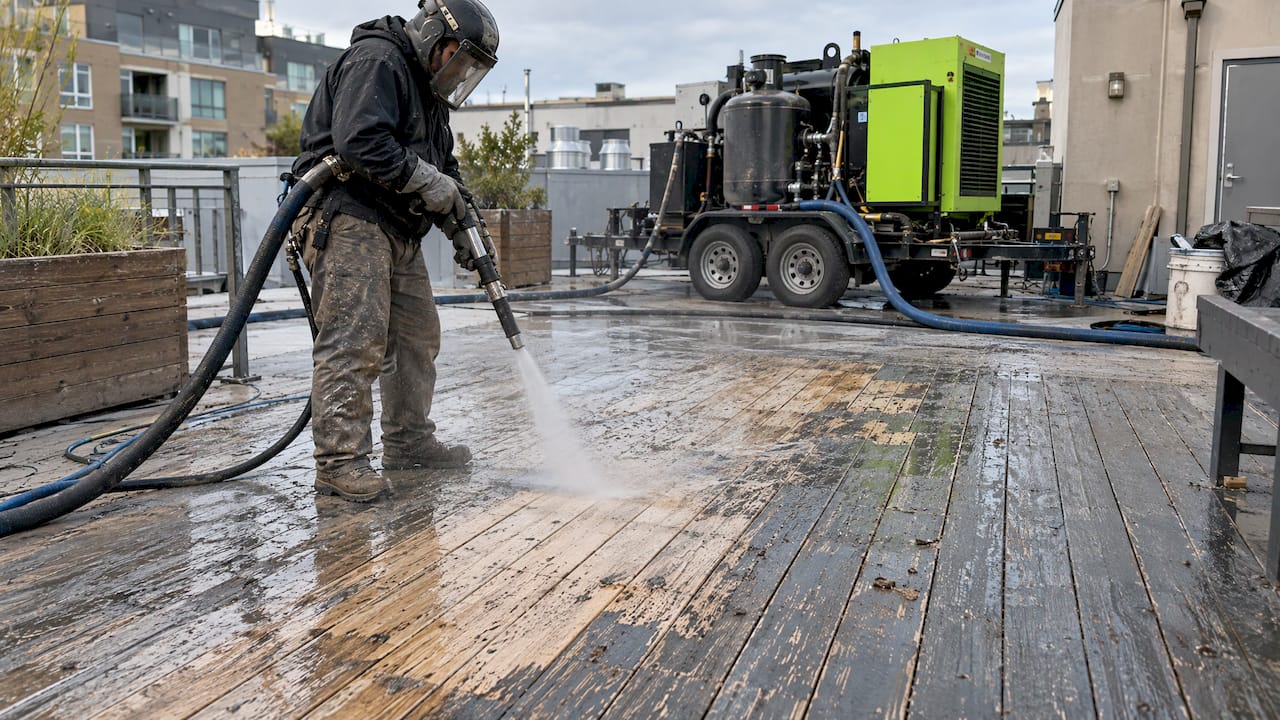
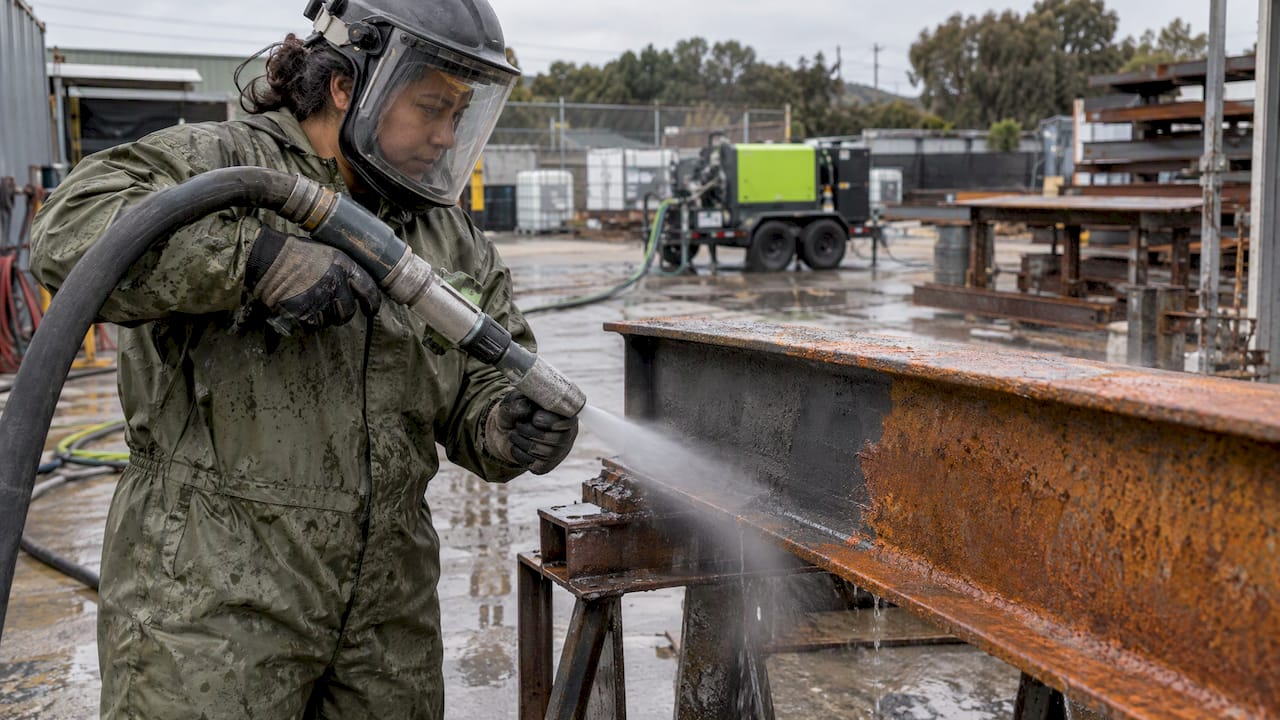
Dustless blasting mixes water into the abrasive stream, so far less dust becomes airborne. Our rigs produce up to 92% less dust than traditional dry sandblasting, and that is the reason property owners ask us about older painted steel, masonry and concrete. It is a wet method that suppresses dust at the source, which is the direction the rules point. Containment, collection of the slurry and the contractor’s work plan still decide whether a given job is compliant, so we scope those up front. You can see how the methods differ in our comparison of dustless blasting, sandblasting and pressure washing.
Our lead paint removal and containment page covers the service itself. For brick, see what works when removing paint from brick in San Francisco.
Worker protection under Cal/OSHA
California’s lead standard is stricter than the federal one. Cal/OSHA sets a permissible exposure limit of 10 micrograms per cubic meter over eight hours and an action level of 2, against federal OSHA limits of 50 and 30. That gap is why a California scope includes more than a crew and a rig.
In practice, Title 8, Section 1532.1 means:
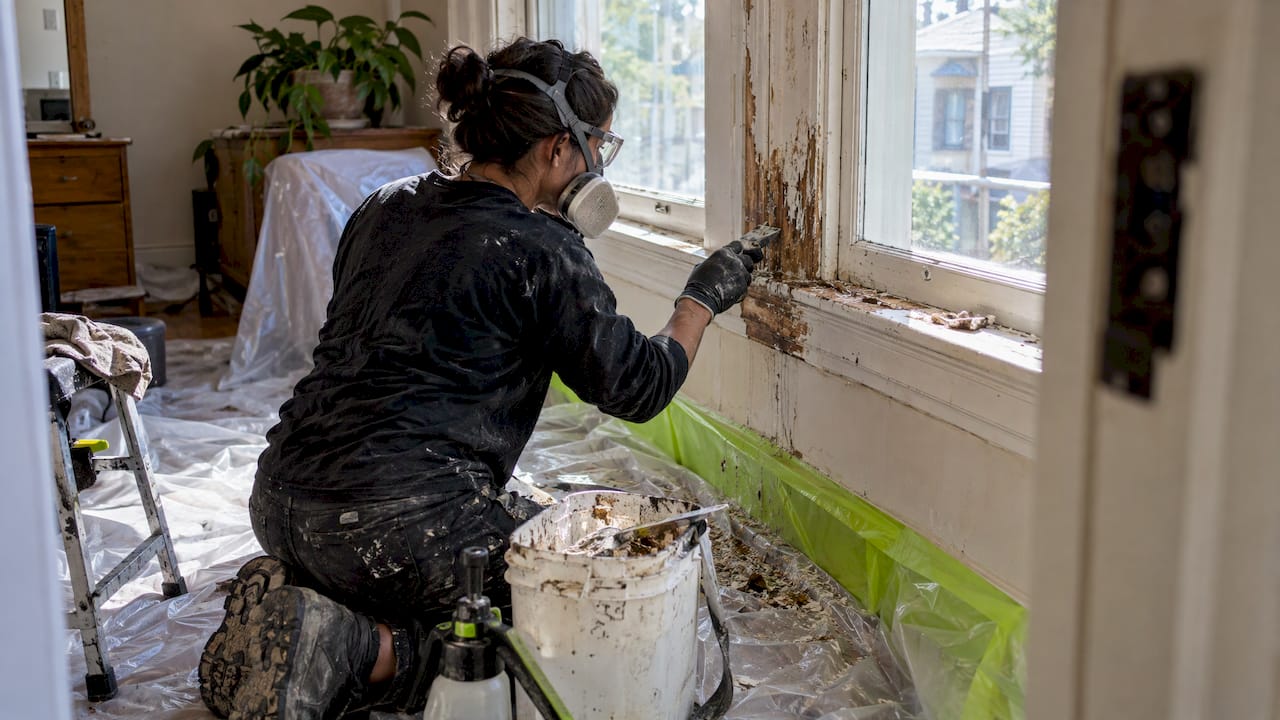
- Respirators when exposure exceeds the limit, when engineering controls are not enough, when a worker asks for one, or as interim protection for trigger tasks.
- Initial blood lead testing before assignment where exposure is or is likely to be at or above the action level, plus medical surveillance, subject to listed exceptions.
Ask any contractor, including us, how these are covered on your job. A clear answer is a good sign.
Containment and the work area
EPA’s Renovation, Repair and Painting rule sets minimum containment for covered work: interior floor covering six feet beyond the surface or far enough to contain dust, and exterior ground covering 10 feet beyond or far enough to catch debris, unless a property line prevents it. For exterior blasting on Bay Area lots, tight setbacks and shared walls are common, so plan how the debris will be caught, not just where the tarps go.
On pricing: surface preparation and blasting jobs are quoted per square foot or per project. Dustless blasting, paint removal and rust and metal blasting start from $3 per sq ft, and surface preparation runs $2-3 per sq ft. Lead paint removal has no published price because containment, access and waste volume change each job. Our Bay Area dustless blasting cost guide shows what moves the number.
Waste: debris, slurry and wash water
Lead waste has to be handled from the first day. Under the EPA rule, lead-containing waste is collected at the end of each work day, stored under containment and contained in transport. Dumping and open burning are not allowed.
The harder question is classification. Debris, paint chips, dust and sludge above the toxicity limit of 5 mg/L lead in the leachate count as hazardous waste under federal law, with an exclusion for household waste. In California, the person generating the waste must determine whether it meets hazardous waste criteria under 22 CCR section 66261.3. For a commercial or multifamily owner, that means you want waste characterization in the contract, with a named party responsible for it.
Water needs the same care. Los Angeles County’s spec requires that lead-contaminated water be filtered before sewer disposal and kept out of storm water, and it bans dry sweeping in favor of HEPA vacuuming, washing and a second HEPA pass. Local sewer agencies set their own rules, so confirm with yours. Leftover paint is its own stream: CalRecycle directs people to paint drop-off locations and prohibits drying paint without a permit to treat hazardous waste.
Cleanup verification and clearance
The job is not done when the paint is gone. In California, abatement meant to last 20 years or more requires a clearance inspection after completion. HUD’s procedure for covered projects has the assessor wait one hour after final cleanup, inspect visually, take dust samples of floors, window sills and troughs, and send them to an NLLAP-recognized lab. HUD also strongly recommends the assessor be independent of the lead hazard control contractor.
The thresholds have tightened. In October 2024, EPA lowered clearance levels to 5 µg/ft² on floors, 40 µg/ft² on window sills and 100 µg/ft² on window troughs. Confirm with your inspector which standard applies to your project.

On the renovation side, EPA’s rule lets a firm skip cleaning verification when a contract or law requires dust-lead sampling by a certified inspector, risk assessor or dust sampling technician, with re-cleaning until results are below the action levels.
A practical sequence for owners and managers
- Confirm the age and test. Pre-1978 means assume lead or test with a certified inspector.
- Decide the goal. Long-term abatement, interim control or prep for recoating each follow different rules.
- Get the scope in writing. Method, containment, who files the CDPH notification, who handles waste classification, and who performs clearance.
- Check funding. Some local housing agencies run lead hazard programs for eligible households, usually income-based and tied to pre-1978 homes. Ask your city or county housing department what is offered where you are.
- Schedule clearance with an independent certified professional before the area is reoccupied or recoated.
Our perspective
Most lead paint trouble we hear about starts with the cheapest method, not the wrong paint. Dry blasting and dry grinding throw lead into the air, onto the neighbors’ side of the fence and into the waste stream. The rules in California, from Cal/OSHA’s low exposure limit to the HUD list of prohibited methods, all push toward controlling dust where it is made.
That is why we work wet. Our self-contained rigs carry their own air and power, so on most sites we need only parking and access to the surface. We produce up to 92% less dust than traditional dry sandblasting, which keeps the work area easier to contain and the cleanup simpler.
Our advice is to settle the paperwork questions before the rig arrives: testing, notification, waste, clearance. Tell us the building age, the surface and the square footage, and we will give you a free estimate and a straight answer on how we would approach it.
USA
Get a quote for your project
We prepare and restore concrete, wood, brick, metal and asphalt across San Francisco and the Bay Area for contractors, property managers and homeowners. Free estimates, quick site visits and fast scheduling are standard. Start with our lead paint removal and containment service, or see everything we do on our services page.

If your project is a paint strip before recoating, our paint removal service and surface preparation service are the closest fits. Call or send us your details through the site for a free estimate.
FAQ
Do I need a licensed contractor to remove lead paint in California?
For abatement designed to last 20 years or more in residential or public buildings, Title 17 requires CDPH-certified lead supervisors and workers. Interim controls under 20 years do not require certification, but other Title 17 requirements still apply. Ask whoever bids your job which category it falls in and who holds the certifications.
Can I test paint for lead myself?
Yes. California allows homeowners to collect paint chip, dust and soil samples or use test kits on their own property. Kits cannot show how much lead paint is present, so a certified inspector or lab sample is the stronger basis for a project scope.
Is sandblasting lead paint allowed?
Federal HUD rules prohibit abrasive blasting in covered housing without HEPA local exhaust control. Cal/OSHA also treats abrasive blasting as a high-exposure task. Wet methods that suppress dust are the direction the rules favor, with containment and waste handling still required.
How should lead paint debris be disposed of?
Collect it at the end of each work day, store it under containment and keep it contained in transport. The waste generator must determine whether it meets California’s hazardous waste criteria. Never dump it, burn it or send contaminated water to storm drains.
Sources
- EPA: Frequent Questions About Testing for Lead-Based Paint
- USDA Forest Service: Lead-Based Paint Testing Methods
- CDPH: Is Certification Required?
- Cal. Code Regs. Tit. 17, § 36100
- CDPH: Types of Certification
- CDPH Form 8551 and 8552
- Los Angeles County Lead-Based Paint Removal Specifications (2017)
- eCFR: 24 CFR 35.140
- Cal/OSHA: Appendix C to Section 1532.1
- Cal/OSHA: Occupational Lead Exposure Prevention Laws and Regulations
- Cal/OSHA: Title 8, Section 1532.1
- EPA: Work Practice Standards Under the RRP Rule
- DTSC: Defining Hazardous Waste
- CalRecycle: Paint Management
- HUD: Chapter 15, Clearance
- EPA: Hazard Standards and Clearance Levels for Lead
- EPA: RRP Regulations, 40 CFR Part 745 Subpart E excerpt