Deck Paint Removal: Methods, Risks and What It Costs
There are four realistic ways to get old paint off a deck: chemical stripper, sanding or scraping, pressure washing, and wet abrasive (dustless) blasting. The right one depends on how well the paint is stuck, what kind of wood is under it, and whether the paint could contain lead. Below we explain each method, the risks that matter, how to get the deck ready for its new coating, and what professional removal costs in the Bay Area.
TL;DR
- Not every painted deck needs stripping. Sound paint can be recoated, while heavy peeling, blistering or a dramatic color change calls for removal.
- Stripper, sanding and pressure washing all work, but each can harm wood if you rush or use too much pressure.
- If the house was built before 1978, treat the paint as possibly lead-based. Paid contractors have to follow EPA lead-safe rules, and dry sanding is a bad idea.
- Our paint removal starts from $3 per sq ft in San Francisco and the Bay Area, with free estimates.
- Let the wood dry fully before you recoat. Surface-dry is not the same as ready.
Table of Contents
- First decide: strip, or just recoat?
- Is the paint lead-based? Check before you scrape
- The main ways to remove paint from a wood deck
- Method comparison at a glance
- What the deck will look like afterward
- Getting the deck ready for its new coating
- Perspective
- What professional deck paint removal costs in the Bay Area
- Book a free estimate
- FAQ
- Sources
First decide: strip, or just recoat?
Start by looking at the paint, not the can of stripper. Cabot’s deck stripping guide says not every deck needs its old coating removed. Stripping makes sense when you want to lighten the opacity of the coating, make a dramatic color change, or deal with extreme weathering such as cracking or blistering.
A simple adhesion check helps you decide. Score an X through the coating down to the wood, press strong adhesive tape flat over it, and pull it off sharply at a 90-degree angle. INSECO describes this tape test: if a meaningful amount of coating comes up with the tape, adhesion has failed and a new coat will not hold.
Two more checks before you commit:
- Find out why the paint failed. The Minnesota Department of Health advises fixing the cause of chipping or peeling, such as a leaking roof or gutter, before removing or covering old paint. New paint over a wet problem fails again.
- Walk the boards. Look for soft spots, rot and loose fasteners. Decks.com recommends inspecting for rot and making repairs before the stripping starts.
Is the paint lead-based? Check before you scrape
If your house or deck predates 1978, assume the paint may contain lead until a test says otherwise. This changes which methods are acceptable.
- The EPA’s Renovation, Repair and Painting (RRP) rule applies to firms and individuals paid to disturb paint in pre-1978 housing. It requires certified firms, trained renovators and set work practices when a job disturbs more than 20 square feet of painted surface on the exterior. A deck floor passes that threshold quickly.
- HUD’s handbook prohibits open-flame burning, heat guns at or above 1,100 °F, and machine sanding or abrasive blasting without HEPA local exhaust when removing lead-based paint.
- The CDC’s field guide for painters tells workers to mist surfaces before scraping and sanding and keep misting while they work.
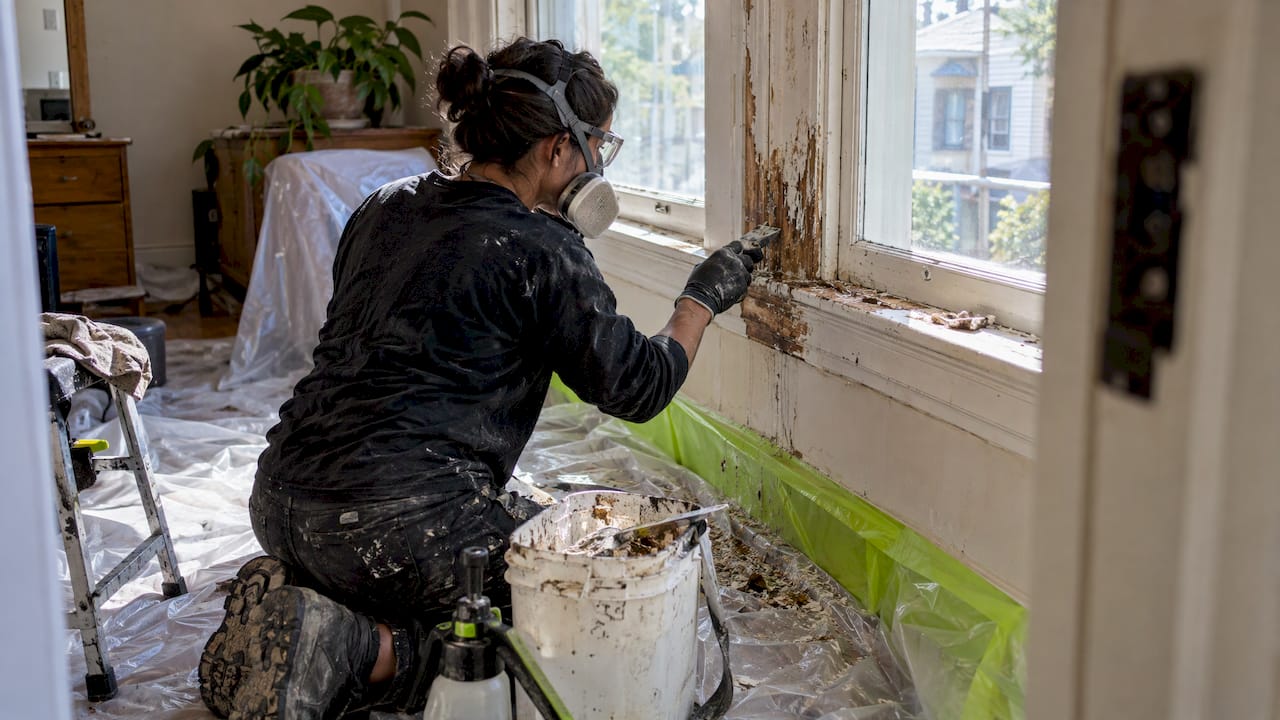
- The Minnesota Department of Health also advises against dry-sanding lead-based paint and against heat guns at 700 degrees or above, and it asks you to tell neighbors in advance so they can keep dust out of their homes (same state health guidance).
For a deck on an older property, the safest path is a lead test and, if it is positive, a contractor set up for containment. We cover the California side in our guide to lead paint removal rules, methods and costs, and our lead paint removal service page explains how we contain the work.
The main ways to remove paint from a wood deck
Chemical stripper
Stripper softens the coating so it can be scraped and rinsed off. TimberTech explains that strippers fall into two main groups, caustic-based and solvent-based. Gel formulas stay wet longer and suit large decks, while water-based ones dry quickly and fit small jobs.
The usual sequence, per Decks.com:
- Clear the deck and cover nearby plants and surfaces.
- Knock off the worst flaking paint with a hand scraper or pressure washer.
- Apply stripper in sections no larger than 10 by 10 feet and keep the wood wet.
- Wait the manufacturer’s dwell time, then scrape with a putty knife and scrub with a stiff nylon brush.
- Rinse thoroughly and apply a brightener/neutralizer.
Read the label on whatever you buy. One current wood stripper from Cabot contains sodium hydroxide, causes eye and skin burns, calls for acid-resistant gloves, goggles, boots and a dust mask, and must never be mixed with ammonia or acids because that releases hazardous gases.
Sanding and scraping
Sanding is the finishing step for most methods and the main method for small areas. Decks.com suggests starting at 80-grit and moving up to 100 or 120. TimberTech’s advice is a little more specific: 80 to 100 grit for softwoods and 100 to 120 for hardwoods.
Sand with the grain, brush away dust between grits, and wear goggles and a mask. On a whole deck floor this is slow, and on a pre-1978 deck dry sanding is exactly what the lead guidance above warns against.
Pressure washing
Pressure is a trade-off. Consumer Reports recommends 800 to 1,000 PSI for wood decks, with a low-pressure nozzle on soft woods like Southern yellow pine, and its test engineer notes that a stream can nick or etch wood. After chemical stripping, both TimberTech and Dunn Lumber cap the washer at 1,000 PSI to rinse off the loosened coating without damaging the wood.
The pressure that actually lifts cured paint is far higher, which is why a washer alone tends to leave a patchy, fuzzy surface. Use it for rinsing and cleanup rather than as the whole job.
Heat
A heat gun softens paint so it blisters and can be scraped, but it is not suitable if lead is possible, and an open flame is never appropriate. Keep it off any deck you have not tested.
Wet abrasive (dustless) blasting
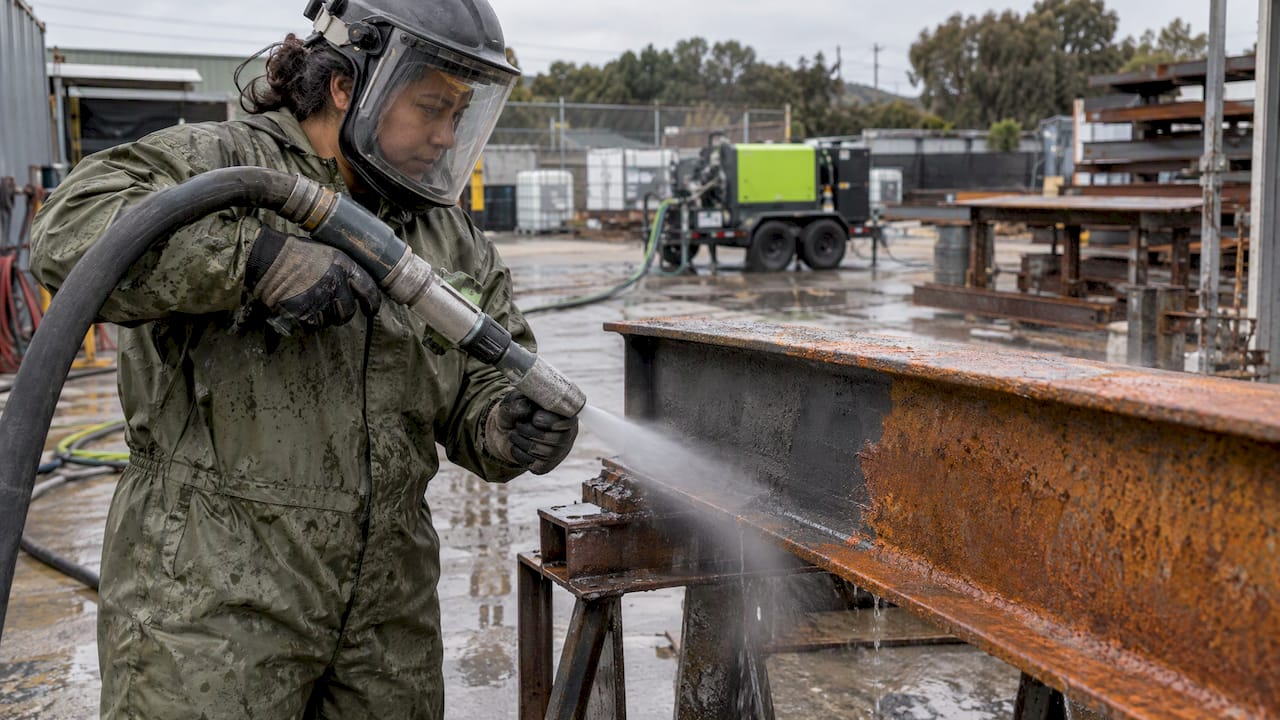
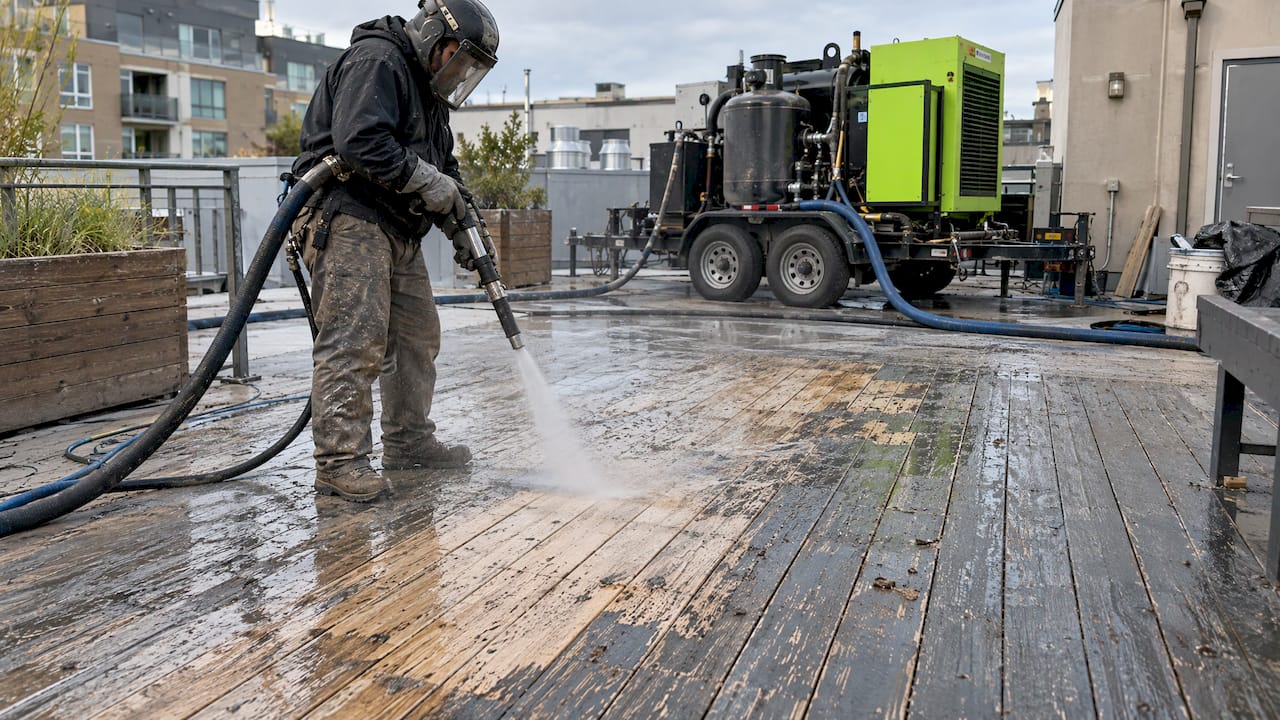
This is what we do. Dustless blasting carries abrasive in a water stream, so the paint is taken off mechanically without soaking the deck in stripper and without the dust cloud of dry sandblasting. Our rigs are self-contained, carrying their own air and power, so we need parking and access to the deck, not your utilities. We design the process to produce up to 92% less dust than traditional dry sandblasting.
For a side-by-side look at what each method removes, see our comparison of dustless blasting, sandblasting and pressure washing.
Method comparison at a glance
| Method | Best for | Watch out for | Effort |
|---|---|---|---|
| Chemical stripper | Flat boards, moderate paint build-up | Caustic burns, dwell times, neutralizing, runoff | High, multi-day |
| Sanding / scraping | Small areas, final smoothing | Dust, gouging, lead on older paint | High |
| Pressure washing | Loose paint, rinsing after stripper | Etching and fuzzing the wood above ~1,000 PSI | Medium |
| Heat gun | Small spots on tested, lead-free paint | Scorching, lead fumes | Medium |
| Dustless blasting | Whole decks, railings, stairs, tight spaces | Needs a trained crew and access for the rig | Handled by the contractor |
What the deck will look like afterward
Set expectations honestly. Dunn Lumber points out that a stripper removes the coating but does not make the wood new: you get the same boards, with whatever blemishes they had. It also notes that if a previous owner painted the deck, there may have been a good reason, such as weathered or stained boards. Plan on a solid-color or semi-solid finish if the wood is patchy once exposed.

Getting the deck ready for its new coating
Bare wood is only half the job. The prep decides whether the new finish lasts.
- Neutralize. After stripper, rinse well with fresh water and use a brightener/neutralizer to reset the wood’s pH so the new finish can bond, as Dunn Lumber advises.
- Dry completely. Decks.com says to let the deck dry for several days before sanding. A professional painter quoted by Family Handyman recommends at least three rain-free days after washing before staining, and restarting the count if it rains. Moisture trapped in the wood can make the new coating fail (Family Handyman).
- Sand lightly. Smooth out raised grain and marks. Decks.com notes you should not need to go much finer than 150 grit to remove sanding marks.
- Coat within the product’s window. Follow the stain or paint maker’s instructions for temperature and recoat timing.
In the Bay Area, a dry spell between fall rains and spring is the practical window for this work, so scheduling ahead helps.
Perspective
Most deck paint jobs we get called about have already been through one or two attempts: a scraper, a rented washer, a can of stripper. The deck is half bare, the grain is fuzzy, and the owner wants it done properly.
Our view is that a deck is a poor place to spend a weekend fighting paint. Chemical stripper means neutralizing and rinsing runoff. Sanding means hours of dust. Pressure washing hard enough to lift paint risks cutting into the boards. Wet abrasive blasting does the removal in one pass, with far less dust, and our rigs carry their own air and power, so we only need parking and access.
On older homes, the first question we ask is the year of the house. If lead is possible, we plan containment before anything else. That is not a delay, it is how the job gets done safely and legally.
Tell us the size of the deck, what is on it and what you plan to put back on. We give you a free estimate and a straight answer on method.
USA
What professional deck paint removal costs in the Bay Area
Our paint removal is priced from $3 per sq ft, and we quote per square foot or per project. A 300 sq ft deck therefore starts at $900 at that rate, before access, paint build-up, railings and stairs are factored in. Those details are what move a quote up or down, and we explain them in our dustless blasting cost breakdown for the Bay Area.
Lead paint removal has no published price because containment requirements vary by site. We price it after we see the job.
To sanity-check any quote you receive, ask for the price per square foot, what is included (railings, stairs, cleanup), and how the contractor handles pre-1978 paint.

Book a free estimate
We remove paint from decks, railings, fences, siding and more across San Francisco and the Bay Area, working for homeowners, contractors and property managers. Our paint removal service starts from $3 per sq ft, with free estimates and quick scheduling. If the deck is the first step in a bigger restoration, our guide to restoring wood siding shows how we handle the repair, strip and refinish sequence.

Send us the deck’s approximate size, the age of the house and a few photos through our services page, and we will come back with a clear number.
FAQ
How do you remove paint from a wooden deck?
The common DIY route is to scrape off loose paint, apply stripper in small sections, scrape and scrub, rinse, neutralize and sand. A professional alternative is wet abrasive blasting, which removes the coating mechanically with less dust. If the house predates 1978, test for lead first.
Is it better to strip or sand a deck?
Strip first when paint is thick or covers a large area, then sand to smooth the wood. Sanding alone works for thin coats and small spots but is slow and creates dust. On a possible lead-paint deck, avoid dry sanding altogether.
Do dish soap or WD-40 remove deck paint?
Neither is a reliable paint remover for cured exterior paint. One woodworking site says it dropped older vinegar and baking soda advice because it found no source showing they soften cured exterior paint. A real stripper or a mechanical method is what actually works.
Can I pressure wash paint off a deck?
Only loose, flaking paint comes off at deck-safe pressure. Consumer Reports suggests 800 to 1,000 PSI for wood decks, and higher pressure can etch the boards. Use the washer for rinsing, not as the only tool.
How long until I can repaint or stain after removal?
Allow several days of dry weather and let the wood dry thoroughly. Professionals quoted by Family Handyman suggest at least three rain-free days after washing. Check the coating maker’s instructions for the exact window.
Sources
- Three Steps for Stripping Your Deck, Cabot Stain
- Problem Solver Wood Stripper, Cabot Stain
- How to Remove Paint and Stain from a Wood Deck, Decks.com
- How To Remove Paint from a Wood Deck, TimberTech
- How to Remove Paint from Your Deck, Dunn Lumber
- Recoat vs. strip, INSECO
- Can You Pressure-Wash It?, Consumer Reports
- A Full Guide to Power Washing the Deck, Family Handyman
- Exterior Lead Paint Removal, Minnesota Department of Health
- Chapter 11: Interim Controls, HUD
- A Field Guide for Painting, Home Maintenance, and Renovation Work, CDC
- EPA Lead-Based Paint Program Frequent Questions
- How to Remove Paint from a Wood Deck, Woodworking Advisor