Concrete Stain Removal: What Works for Each Stain Type
The fastest way to remove a stain from concrete is to identify what caused it, then match the cleaner to that stain. Oil and grease need a degreaser, rust needs a rust-specific treatment, and dirt or algae usually need only detergent, a stiff brush and water. Paint, coatings and stains that have soaked deep into the slab usually need a different approach, such as a poultice or mechanical surface removal. Below, we cover each stain type, the safety steps, and the point where it makes sense to bring in a crew.
TL;DR
- Identify the stain first. The wrong product can spread or set a stain, so test in a small, hidden spot before treating the whole area.
- Start mild: water, a little detergent and a stiff nylon brush. Move to degreasers, rust removers or acids only when the milder step has not worked.
- Dried or deep stains often need a poultice, which holds a cleaning solution on the stain and draws it out of the pores.
- Paint, graffiti, heavy rust and stains on large floors are surface-removal jobs. We handle them with mobile dustless blasting and grinding, with free estimates in the Bay Area.
- Seal clean concrete and blot spills quickly. That is what keeps the next stain from soaking in.
Table of Contents
- Start by identifying the stain
- Which method fits which stain
- Removing oil and grease stains
- Removing rust stains
- Cleaning dirt, algae and general grime
- Paint, graffiti and coatings are a different problem
- Can you remove a stain after it has dried?
- Safety and protecting the surroundings
- When it makes sense to call a crew
- What professional stain and coating removal costs
- Stained concrete floors: grind and seal or polish
- Get a free estimate
- Keeping concrete from staining again
- FAQ
- Sources
Start by identifying the stain
Concrete is porous. A spill does not sit on top like it does on a countertop. It travels into the surface, and the chemistry of the stain decides how you get it out. The Concrete Masonry and Hardscape Association (CMHA) advises identifying the staining substance and choosing its removal agent before treatment. If you do not know the cause, it says to try methods in an inconspicuous area, because an unsuitable product can spread or worsen the stain.
The National Park Service makes the same point in its masonry cleaning guidance: begin by identifying the stain and addressing its source. It also notes that porous masonry is more prone to penetrating stains, and that acids should not go on acid-sensitive materials.
Some clues you can read from the slab itself:
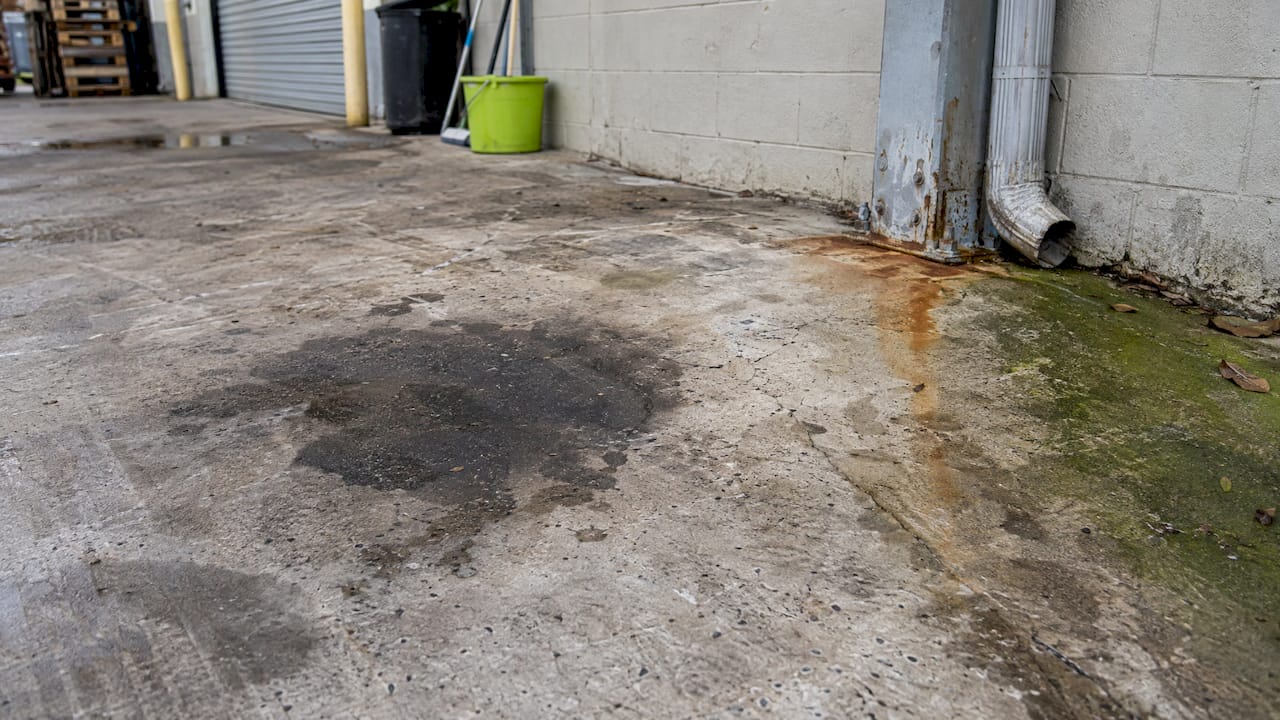
- Dark brown or black patches in a driveway or garage often point to oil, grease, asphalt or similar petroleum products.
- Orange or reddish-brown streaks usually trace back to rusting metal: furniture legs, rebar near the surface, tools, or a leaking fence post.
- Green, gray or black film in damp, shaded areas is typically organic growth or ground-in dirt.
- White, chalky deposits are commonly linked to moisture moving through the slab, known as efflorescence.
- A colored film with a visible edge is usually paint, sealer or another coating.
If you manage a building with both indoor floors and outdoor slabs, it helps to keep routine floor care in good order so spills do not get walked into the surface. A service such as professional hard floor care can help with that kind of upkeep, while deeper stains in the concrete itself call for the methods below.
Run a spot test before you commit
Pick a spot that will not be seen, such as a corner under a planter or near a wall. Apply the cleaner, wait the stated time, rinse, and let it dry. Concrete often looks different wet than dry, so judge the result only once the spot is fully dry. If the spot looks lighter or etched, you will see the same effect across the whole treated area.
Which method fits which stain
| Stain | First method to try | If it remains |
|---|---|---|
| Dirt, leaves, general grime | Dish soap or mild detergent, warm water, stiff brush | Pressure washing on a suitable setting |
| Fresh oil or grease | Absorbent such as clay cat litter or sawdust | Degreaser or TSP solution, then a poultice |
| Old oil or grease | Degreaser, scrub, dwell, rinse | Poultice, repeated as needed |
| Fresh rust | White vinegar, 10-minute dwell, nylon brush | Commercial rust remover |
| Old or large rust | Commercial rust remover | Mechanical removal |
| Paint, graffiti, coatings | Surface removal beyond ordinary cleaners | Dustless blasting or grinding |
Each row is a starting point. The label on any commercial product governs dwell time, dilution and protective gear.
Removing oil and grease stains
Oil is the most common stain on garage floors, driveways and loading areas, and it is easier to treat the sooner you act.
Fresh spills. The Home Depot recommends blotting right away with absorbent material such as paper towels, spill absorbers, sawdust or cat litter. It says to clear surrounding debris, let the absorbent work for 24 hours, then sweep it away.
Remaining stain. Bob Vila’s guide describes clumping clay cat litter left for at least an hour, or overnight for large or old stains. After that, it treats what is left with 1 cup of TSP (trisodium phosphate) in 1 gallon of hot water, at least 30 minutes of soaking, scrubbing with a nylon brush and a thorough rinse.

Commercial degreasers. Product instructions vary, so follow the label. As one example, Rust-Oleum’s heavy-duty degreaser instructions call for full strength on tough stains, a 1:4 dilution for general cleaning, and a wait of at least 2 hours before flushing and squeegeeing dry. Another example, QUIKRETE’s cleaner, etcher and degreaser, says to sweep first, remove standing oil, and work in sections of about 5 by 5 or 10 by 10 feet. It also warns that concentrated or prolonged contact can etch the concrete.
A few habits that help with any degreaser:
- Wet the concrete first so the solution does not sink straight in.
- Scrub with a stiff nylon or fiber brush. CMHA advises against steel wire brushes, which can leave metal particles that rust later.
- Keep to the stated dwell time. Longer is not better, and some products etch the surface.
- Rinse thoroughly and let the slab dry before judging the result.
- Repeat if the stain has only lightened. Older oil stains often take more than one pass.
Removing rust stains
Rust stains are iron oxide, and ordinary detergent will not lift them. Bob Vila says fresh rust may respond to white vinegar with a 10-minute dwell and nylon scrubbing, while old or large stains may need a commercial rust remover. For those, wear eye and hand protection and follow the label’s dwell time.
Two cautions apply here. First, do not mix cleaners. QUIKRETE’s data sheet specifically says not to mix its cleaner with bleach or other chemicals. Second, find the source. If a metal fixture keeps dripping rust, the stain will come back no matter how well you clean it. Move the planter, repaint the railing, or replace the leaking part.
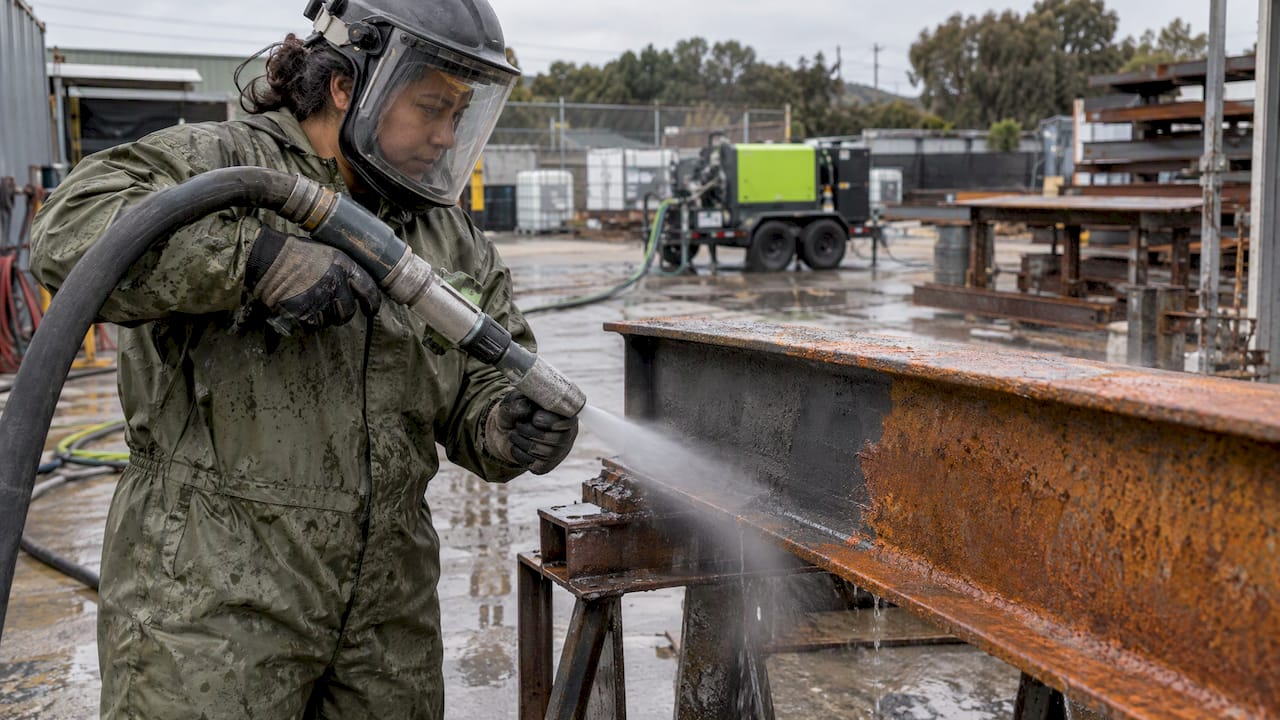
When rust is on the steel itself, such as gates, rails, beams or equipment, the job is metal prep rather than concrete cleaning. We cover that on our rust removal and steel blasting page.
Cleaning dirt, algae and general grime
Most outdoor concrete stains are not chemical at all. They are soil and organic growth. CMHA says unpainted walls can usually be cleaned by scrubbing with water and a small amount of detergent, and that clay or dirt should be dry-brushed off first. The same source lists pressure washing among the appropriate tools where the surface can take it.
For rinsing porous concrete, PROSOCO’s cleaner and degreaser data sheet lists 400 to 1,000 psi at 6 to 8 gallons per minute as a rinse combination, and gives 50°F or higher as the best cleaning temperature. Higher pressure and a narrow tip can scar a slab, so start gentle and test.
If you are deciding between washing and blasting for a tougher surface, our comparison of dustless blasting, sandblasting and pressure washing shows what each one removes.
Paint, graffiti and coatings are a different problem
Stain cleaners are designed for stains, which are materials that soaked into the concrete. Paint, sealers, epoxy, striping and graffiti are layers that sit on or bond to the surface. ASTM E1857 is a guide for selecting, testing and evaluating cleaning techniques for soiling and staining on masonry, concrete and stucco, and it notes that paint, coatings and graffiti may require measures beyond its scope.
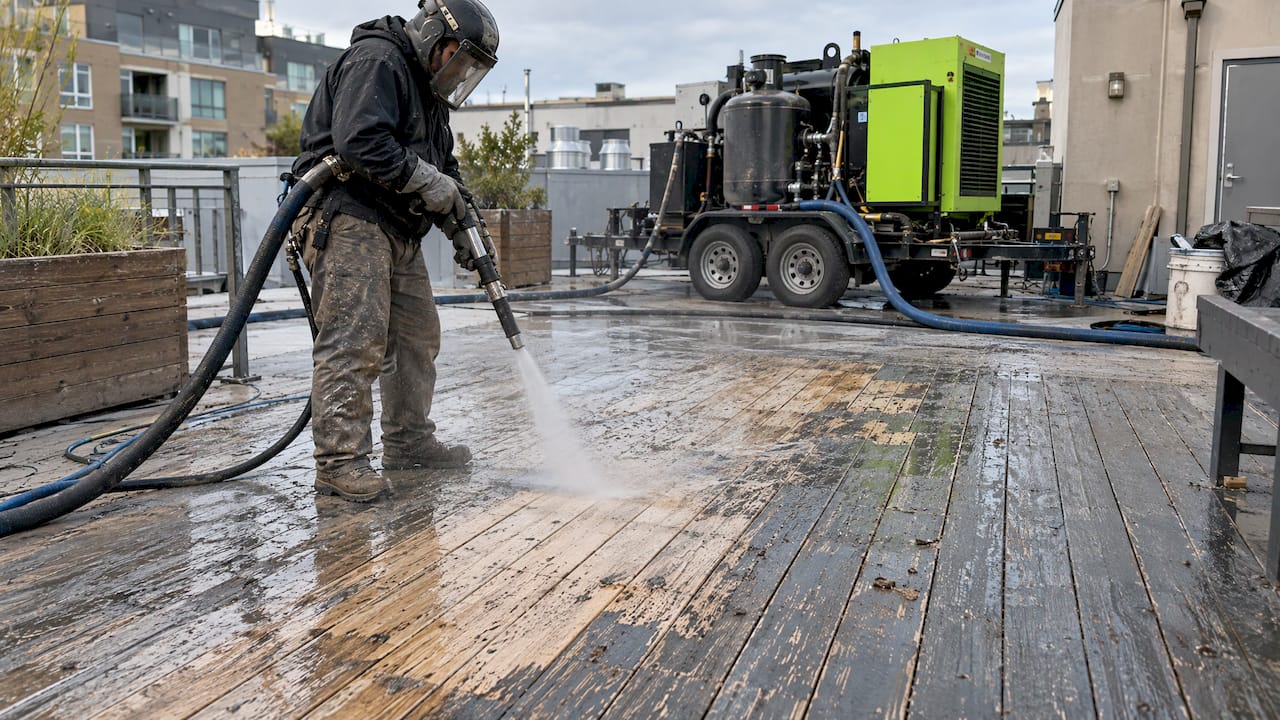
This is where mechanical removal earns its place. Wet abrasive (dustless) blasting strips the layer back to bare concrete, and grinding takes off a thin top layer of the slab. Depending on the surface and the finish you want, we use one or the other, or both. If your target is a coating, our pages on paint removal, graffiti removal and line and stripe removal explain the process by surface.

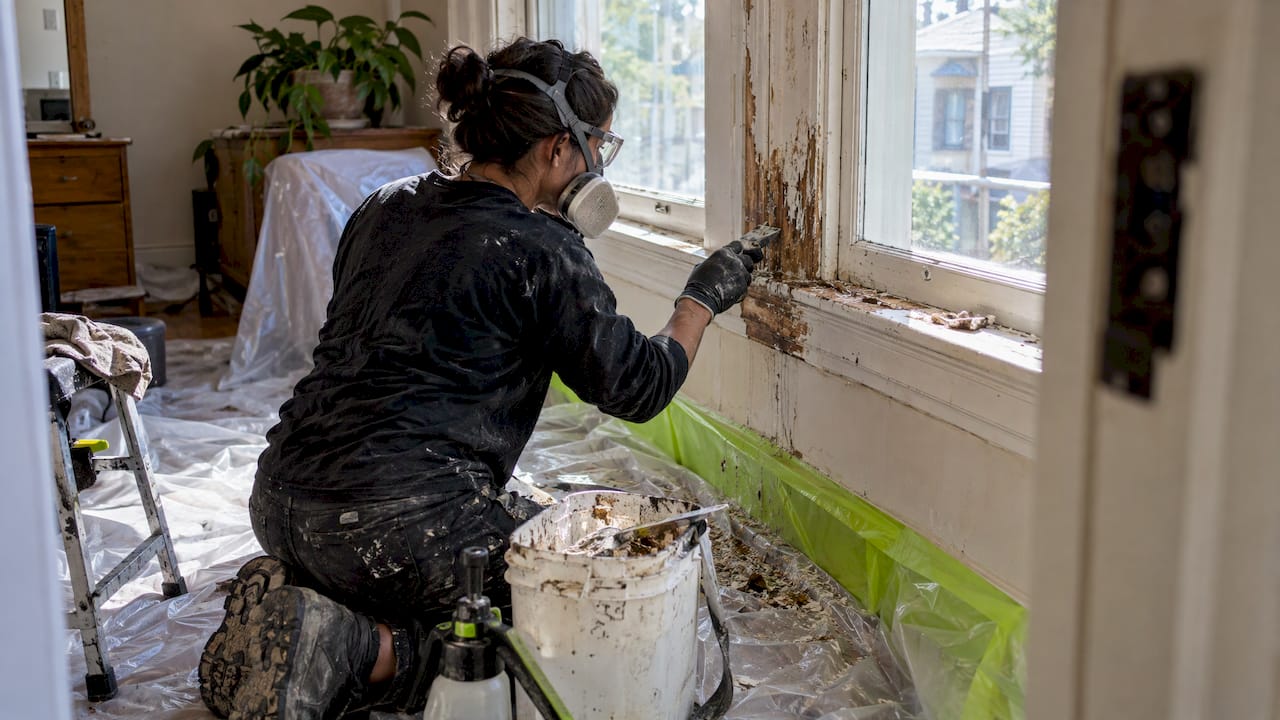
Older buildings need extra care. If paint may contain lead, the work needs containment and proper handling, which is the reason we offer lead paint removal and containment as its own service.
Can you remove a stain after it has dried?
Often yes, but it takes more patience. Dried stains have had time to move into the pores, so surface scrubbing mostly lightens the top. The National Park Service explains that poulticing is generally the most effective method for stains in masonry because it keeps a compatible cleaning solution in contact with the stain and draws the material out without spreading it.
A poultice is a paste of an absorbent powder, such as talc or diatomaceous earth, mixed with the cleaning agent suited to the stain. In outline:
- Pre-wet the concrete and remove any loose material.
- Mix the absorbent with the chosen solvent or cleaner into a thick paste.
- Spread it over the stain, slightly beyond the edges, in a layer about 1/8 to 1/4 inch thick. That thickness comes from a federal grease-removal procedure published by the GSA.
- Let it dry completely, then scrape it off with a wooden or plastic spatula.
- Rinse and let the slab dry. Repeat if the stain is still visible.
If you do not know the stain, professionals work from mild to strong. A General Services Administration testing sequence for unknown stains starts with organic solvents, then oxidizing bleaches, then reducing bleaches, and acids last, testing a hidden area at each step. CMHA likewise treats acids as a last resort.
Safety and protecting the surroundings
Many concrete cleaners are corrosive. QUIKRETE’s data sheet says to use impervious gloves, eye protection, rubber boots and adequate ventilation, to use compatible plastic tools, and to control runoff. It warns that the product can burn eyes and skin. Read the safety data sheet for whatever you buy, and keep children and pets off the slab until it is rinsed and dry.
Also protect what is around the stain. PROSOCO’s data sheet recommends protecting people, vehicles, property, polished masonry and concrete from product, residue, splash, fumes and drift. In California, do not let cleaning runoff reach storm drains. Collect it and ask your local water agency how to dispose of it.
Expect some color change too. CMHA notes that a treated area may look lighter because cleaning removes surrounding dirt or slightly bleaches the surface. Sometimes the whole wall or slab then needs treatment so it matches.
What we see on Bay Area jobs
Most stain calls start the same way: someone tried a store-bought cleaner, the spot got lighter, and the outline stayed. On concrete that has soaked up oil for years, or has paint and coatings over it, a cleaner only works at the surface. Our approach is to remove the stained or coated layer itself.
Our self-contained rigs carry their own air and power, so we need only parking and access to the surface. Wet abrasive blasting removes paint, rust and coatings from concrete, wood, brick, metal and asphalt while producing up to 92% less dust than traditional dry sandblasting. For floors, concrete grinding takes off the stained top layer and prepares the slab for a seal or polish.
For contractors and property managers, the real question is rarely whether the stain can come out. It is whether the surface will be ready for the next coating. Surface prep to coating spec is part of how we quote the job, so you are not paying twice.
USA
When it makes sense to call a crew
Cleaning by hand works well on small, fresh, single-cause stains. A professional crew becomes the practical choice when:
- The area is large, such as a warehouse floor, loading dock, parking structure or an entire driveway.
- The stain is old and has gone through several failed cleaning attempts.
- The concrete carries paint, epoxy, sealer, striping or graffiti.
- A new coating is going on and the manufacturer requires a clean, profiled surface.
- The site is occupied, so dust and fumes need to stay low.
That last point matters on coating jobs. Manufacturer instructions go beyond visual cleanliness. Rust-Oleum’s U.S. instructions call for cured concrete (at least 30 days for new pours), removal of oil and loose contaminants, compatible cleaning, complete rinsing and adequate drying before coating. A slab that looks clean but still holds oil can cause a coating to fail.
What professional stain and coating removal costs
We quote per square foot or per project, with free estimates. Our published starting prices are:
| Service | Published price |
|---|---|
| Dustless blasting | From $3 per sq ft |
| Paint removal | From $3 per sq ft |
| Rust and metal blasting | From $3 per sq ft |
| Concrete grinding and grind and seal | From $2 per sq ft |
| Surface preparation | $2-3 per sq ft |
Final pricing depends on the surface, the coating or stain depth, access and the finish you need. Our Bay Area cost guide explains what moves the price. Concrete polishing, graffiti removal, line and stripe removal, wood restoration, masonry cleaning and lead paint removal do not have a published price, so we quote them after a site look.
Stained concrete floors: grind and seal or polish
On an interior slab, a stain can be removed with grinding, and the surface can then be finished. Grind and seal gives a protected, easier-to-clean floor at a lower cost, and polishing gives a denser, glossier finish. Our comparison of polished concrete, grind and seal and epoxy covers which suits garages, warehouses and retail. You can also read the details on concrete grinding and grind-and-seal and concrete polishing.
Get a free estimate
If you have a stain, a coating or a whole slab to restore in San Francisco or the Bay Area, send us a few photos and the approximate square footage. We will tell you which method fits, give you a free estimate and schedule quickly. Our rigs come to you and need only parking and access.

See everything we do on our services page, or start with dustless blasting if the stain sits under paint or rust. Tell us what you know about the stain and the surface, and we will sanity-check the approach before anyone shows up.
Keeping concrete from staining again
Prevention costs less than removal, and it is simple:
- Blot spills at once. Use absorbents, remove the debris around the spill, and sweep up the absorbent after 24 hours, as the Home Depot guide describes.
- Seal the slab. Cemstone’s exterior concrete guide says sealing helps keep moisture and deicing chemicals out of concrete. It suggests resealing per the manufacturer, and considering it when water no longer beads on the surface.
- Clean on a schedule. Cemstone recommends sweeping, rinsing or power washing, and removing fertilizer and spills promptly. It also advises avoiding acids not designed for concrete, and letting power-washed concrete dry at least 72 hours before sealing.
- Fix the source. Repair oil leaks, redirect downspouts and move rusting metal off the slab.
FAQ
Can you remove a stain even if it has dried?
Yes in many cases, though dried stains take longer. Because the stain has soaked into the pores, a poultice usually works better than scrubbing, and it may need repeating. Paint and coatings are removed by blasting or grinding rather than by cleaners.
What dissolves cement stains?
Cement splatter and mortar film are alkaline mineral deposits, which are commonly treated with a masonry-safe acidic cleaner. Acids can etch concrete and harm acid-sensitive materials, so follow the label and test a hidden area first. Heavy cement buildup is better removed mechanically.
Can I use bleach or vinegar on concrete?
Vinegar is sometimes used on fresh rust, with a short dwell and a thorough rinse. Bleach is one of the oxidizing agents used in staged stain testing, but never mix it with other cleaners, because some combinations release hazardous fumes. Always read the product label first.
How do I know if I need blasting instead of cleaning?
If the discoloration is a layer you can see or scratch, such as paint, epoxy, sealer or striping, cleaners will not take it off. The same goes for deep, old oil staining across a large area. We can look at photos and tell you which method fits.
Sources
- Removal of Stains From Concrete Masonry, CMHA
- Keeping It Clean: Removing Exterior Dirt, Paint, Stains and Plant Growth, National Park Service
- Standard Testing Sequence for Removing Unknown Stains from Concrete, GSA
- How to Remove Concrete Stains, Bob Vila
- How to Remove Stains From Concrete, The Home Depot
- Product application instructions, Rust-Oleum
- Cleaner Etcher Degreaser data sheet, QUIKRETE
- Cleaner/Degreaser product data sheet, PROSOCO
- ASTM E1857 Standard Guide for Selection of Cleaning Techniques
- Exterior Concrete Maintenance Guide, Cemstone
Recommended
- Removing Paint from Brick in San Francisco: What Works, What Doesn’t, and the One Coating We Won’t Touch
- Dustless Blasting vs. Sandblasting vs. Pressure Washing: Which Removes What
- Polished Concrete vs. Grind & Seal vs. Epoxy: Choosing a Floor for Bay Area Garages, Warehouses and Retail
- Paint Removal & Stripping Contractor | SF Bay Area