Ask any coating manufacturer why their floor peeled and the answer will be the same: prep. The resin was fine; it was applied over a slab that was too smooth, too wet, too dirty, or still had an old coating in the pores. This is the prep side of the job as we do it for coating contractors and facility managers across the Bay Area.
What "profile" means
Coatings need something to grip. The International Concrete Repair Institute (ICRI) defines surface profiles on a scale from CSP 1 (nearly smooth) to CSP 10 (very rough). Most floor coatings specify:
- CSP 1–2 — thin-film sealers and stains
- CSP 2–3 — epoxy and polyaspartic systems up to ~20 mils; this is the usual spec
- CSP 3–5 — thicker urethane cement, mortar systems, self-levelers
- CSP 5+ — heavy overlays and repair mortars
Check the data sheet for the product you're using. If it says CSP 3 and the slab is at CSP 1 because someone acid-etched it, the floor will fail at the wheel paths within a year.
Grinding vs. blasting for floors
Diamond grinding is the default for interior floors. Planetary grinders with 30–40 grit metal-bond diamonds remove curing compounds, laitance, thin coatings and adhesive and leave a CSP 2–3 profile. It's dust-controlled with HEPA vacuums and works in occupied buildings.
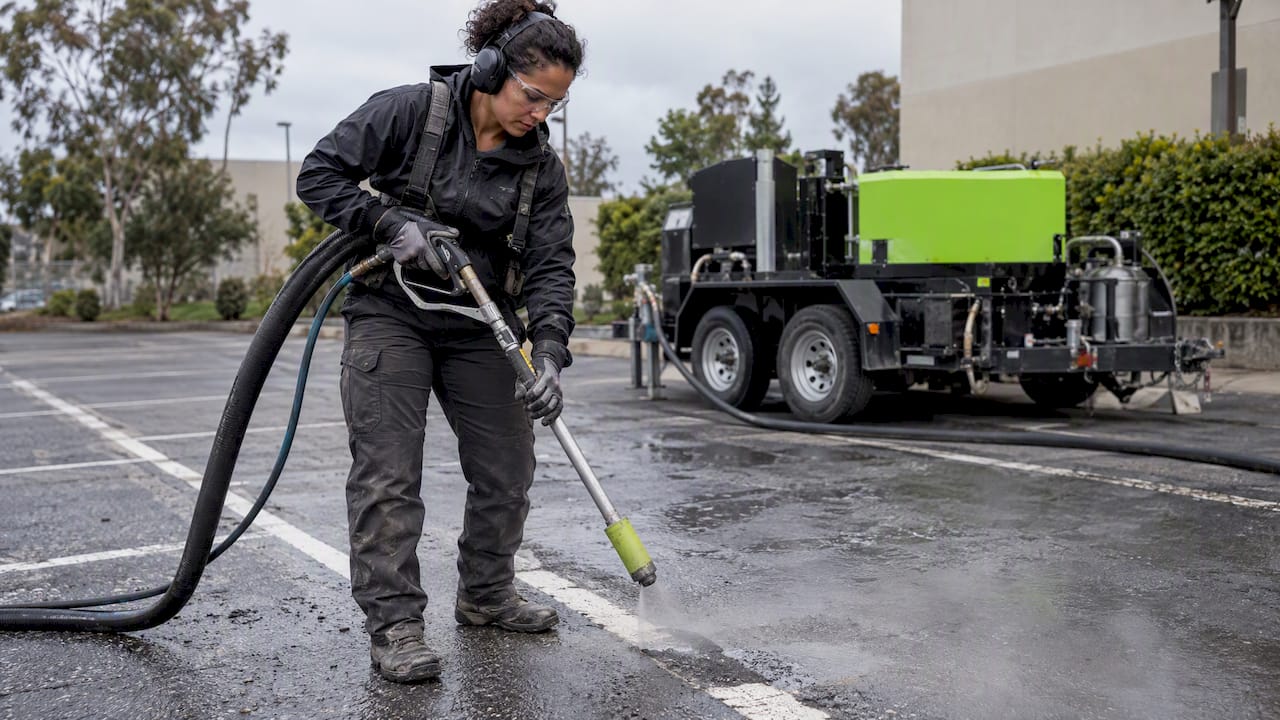
Shot blasting / wet abrasive blasting gets you CSP 3–6 faster on large open slabs, and blasting is the only practical option for thick, hard coatings on walls, curbs, pits and trenches that a grinder can't reach. We use wet abrasive blasting for those areas and for exterior slabs where dust control matters.
We'll often do both on one job: grind the open floor, blast the edges, coves and trench drains.
Old coatings and adhesives
Everything comes off before the new system goes on. Common cases:
- Old epoxy that's half peeling. The bonded half is harder to remove than the failing half. Grinding with aggressive tooling handles it; sometimes a scarifier first.
- Carpet or tile mastic. Black mastic on pre-1980 floors frequently contains asbestos. Have it tested before anyone grinds it. Non-asbestos mastic grinds off with the right tooling.
- Curing compound on a new slab. Invisible and a common cause of early failure. Grinding removes it; a water-drop test shows whether it's there (water beads instead of absorbing).
- Paint lines and striping. Come off with grinding; thermoplastic sometimes needs blasting.
Moisture is the other killer
Bay Area slabs — especially older ones without a vapor barrier, and anything near the Bay — often transmit enough moisture vapor to blister an epoxy film. Before coating, test it: calcium chloride (ASTM F1869) or in-situ RH probes (ASTM F2170). Most epoxies want under 3 lbs/1,000 sq ft/24 hrs or under 75–80% RH. If the slab is over, the coating contractor uses a moisture-mitigating primer. This isn't our part of the job, but we'll flag an obviously damp slab and we won't grind a floor into a shine that hides the problem.
What you get from us
- Slab assessment: coatings, adhesive, cracks, moisture indicators
- Removal and profile to the CSP your product calls for
- Crack and joint prep, including routing for filler
- Vacuum-clean, coating-ready surface, usually same day
- On request: profile documentation and photos for your closeout file
We work directly for coating contractors who want the prep done right on schedule, and for owners who want one company to handle the slab before the coating crew arrives. Scheduling is typically 2–3 days out. Send the square footage and what's on the floor and we'll quote it the same day.