
Line and Stripe Removal: Methods, Costs and Choosing a Pro

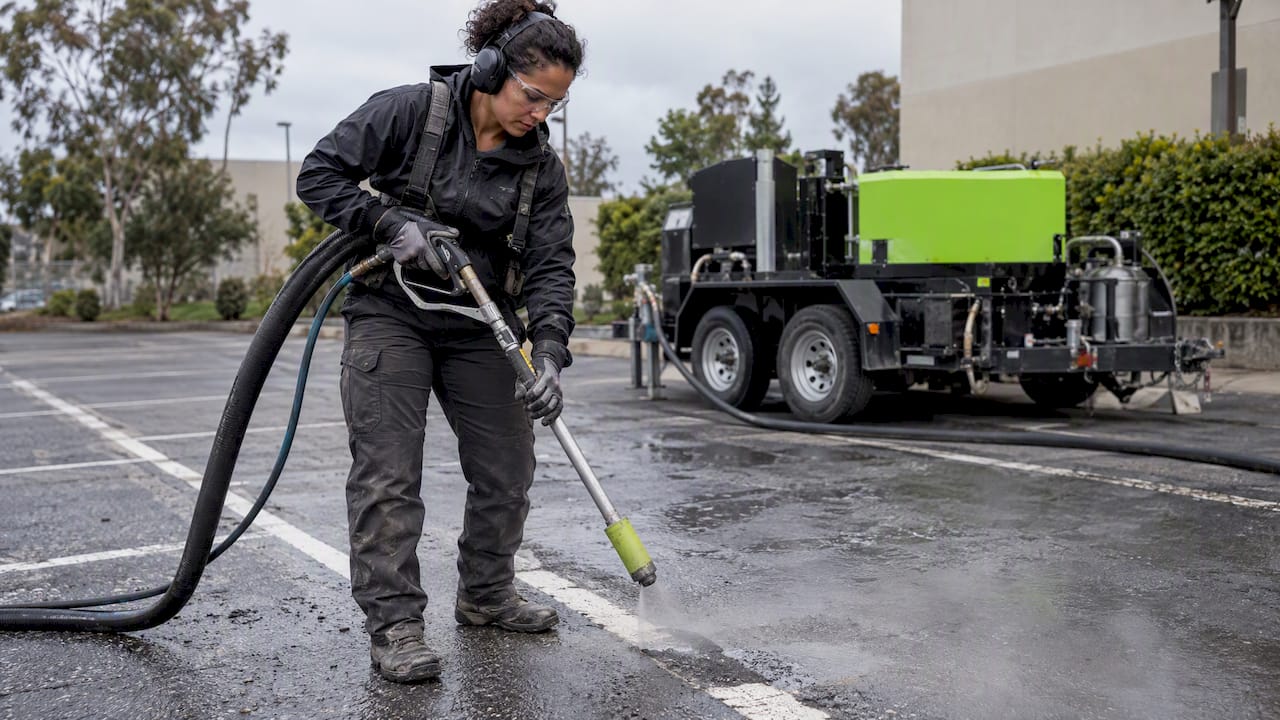
The best way to remove a painted line depends on what the surface is and what you plan to do next. Concrete tolerates more than asphalt. Old or freshly sealed asphalt tolerates the least. The goal is the same in every case: the old marking disappears without a scar that looks like a lane line. We remove parking lot stripes, lane lines and other markings across San Francisco and the Bay Area with mobile wet abrasive (dustless) rigs, and this guide explains how to pick a method, what to ask a contractor and what happens after the line is gone.
TL;DR
- Common methods are chemical removers, water jetting, grinding, shot blasting, sandblasting and burning. No single one is best on every surface, according to federal research on stripe removal.
- Pavement type, age, sealing and condition decide the method. Aggressive grinding on older or recently sealed asphalt is where most damage and ghost lines come from.
- Scars left behind can read as lane markings to drivers, so a clean-looking result matters for safety as well as looks.
- Containment matters: debris and runoff should not reach storm drains or neighboring property.
- We offer free estimates for stripe and line removal. Send us the lot size, surface and what you plan to do next. Request an estimate.
Table of Contents
- What counts as line and stripe removal
- The main removal methods compared
- How to choose a method for your surface
- Why ghost lines happen and how to avoid them
- Containment, cleanup and runoff
- Preparing the pavement after removal
- What line removal costs and what changes the price
- Our work on lines and stripes
- Our perspective on line removal
- Frequently asked questions
- Sources
What counts as line and stripe removal
The term covers any job where paint, thermoplastic or tape markings have to come off a hard surface:
- Parking stall lines and directional arrows in commercial lots and garages
- Fire lane, handicap stall and loading zone markings that need to be redrawn
- Warehouse and factory floor lines on concrete
- Lane lines and crosswalks on private roads and campuses
- Old layouts that must go before a lot is resealed, repaved or restriped
Readers also search for this as pavement line removal. It is the same work. What changes is the surface under the paint and what you want it to look like when we leave.
The main removal methods compared
A federal study of traffic stripe removal lists chemical removers, sandblasting, high-pressure water jets, grinding, hydroblasting and high-temperature burning among the techniques used. The table below summarizes how each behaves in practice, using the research and our own field experience.
| Method | How it works | Best on | Main risk |
|---|---|---|---|
| Chemical removal | A product is applied, left to react, then pressure-washed away | Thin paint on sound surfaces | Can need several applications on thick markings; runoff must be controlled |
| High-pressure water | Water jets lift the marking | Concrete | Less effective on asphalt, and pressure must be chosen carefully to avoid damage |
| Grinding | Rotating abrasive surfaces cut the marking off | Concrete, thick thermoplastic | Typically scars the pavement |
| Shot blasting | Steel shot is thrown at the line and recovered | Narrow lines on durable surfaces | Needs the right machine width to avoid widening the scar |
| Wet abrasive (dustless) blasting | Abrasive in a water stream strips the paint | Paint on concrete, masonry, metal, and many asphalt jobs | Needs an operator who adjusts pressure to the surface |
| Stripe obliteration | The asphalt wearing surface is removed and replaced | Heavily damaged lots, full re-pave projects | Costs more up front |
The Oregon Department of Transportation describes chemical removal as applying a chemical, letting it react and pressure-washing it away, and notes it is one of the least destructive methods. It also notes that thicker or tougher markings may need more than one pass.
How to choose a method for your surface
The same ODOT guidance tells crews to weigh pavement type, age, sealing and condition, and the amount of damage the removal could cause. Their approach is to inspect the work, start with low volume or pressure, and increase only while watching for deterioration. We work the same way.

Concrete floors and slabs
Concrete is the forgiving case. Water-based and abrasive methods work well, and a ground surface can often be sealed or polished afterward. If the line is in a warehouse or garage and you want a new coating, we can combine removal with surface preparation to coating spec in one visit.
Asphalt parking lots
Asphalt is where method choice counts most. The Colorado DOT pavement marking guide notes that pavement marked before 2004, or sealed within the last 3 years, is more susceptible to damage from aggressive methods such as grinding. Non-destructive methods are prioritized there.
For a lot owner this means two questions before anyone fires up a machine:
- How old is the asphalt?
- When was it last sealed?
If you do not know, tell us. We will look at the surface during the site visit.
Thick thermoplastic and tape
Heavier markings take longer. Expect more passes, and expect the contractor to talk about depth control. Ask any bidder how they will keep from cutting into the pavement.
Lots headed for a full re-pave
If the asphalt is failing anyway, removing and replacing the top layer may be the cleaner answer. ODOT describes stripe obliteration as removing and replacing the existing wearing surface, typically the top 2 inches. It costs more initially, gives you a new surface and mitigates ghost striping.
Why ghost lines happen and how to avoid them
A ghost line is the visible trace of a removed stripe: a scar, a stain or a shade difference. The federal study warns that scars and traces can look like lane markings to motorists and create hazardous conditions, so removal should obliterate the marking without leaving them.
The same study observes that grinding and sandblasting are generally slow and can damage pavement when the paint has soaked into the surface. ODOT adds practical limits:
- Start low and slow, and monitor the surface as you go.
- Do not remove more than 1/8 inch of pavement.
- Grinding typically scars the pavement. Rotary erasers tend to reduce damage.
- Water-blasting systems typically have vacuum heads.
Our wet abrasive process is designed to strip paint with adjustable pressure, so the operator can tune the setup to the surface rather than cutting a fixed depth. Because the abrasive is carried in water, it is designed to produce up to 92% less dust than traditional dry sandblasting. Learn more about dustless blasting.
Containment, cleanup and runoff
Line removal makes debris, and in a lot with storm drains that debris is a compliance issue. ODOT’s guidance calls for vacuum-shrouded or equally effective equipment to contain removal materials, equipment in good working order that is not leaking, and steps to prevent runoff into drains, waterways, wetlands or adjacent property.
Before you sign with anyone, ask:
- How will you capture water and debris?
- How will storm drains be protected?
- Who disposes of the waste?
- Is there any chance the old paint contains lead? Older markings and coatings on buildings sometimes do, and that changes how the work is handled. See our page on lead paint removal and containment.
Our rigs are self-contained, with their own air and power. All we need is parking and access to the surface, so there is no need to run utilities from your building.
Preparing the pavement after removal
Once the line is gone, asphalt often needs a repair step before restriping. ODOT’s guidance for asphalt matches the treatment to the removal depth and pavement age:
| Situation | Suggested treatment |
|---|---|
| Less than 1/8 inch removed, surface under 2 years old | Fog seal |
| Older surface or chip seal | Sand seal or asphalt mastic |
| More than 1/8 inch removed, or significant damage | Slurry seal or microsurfacing |
These come from ODOT’s pavement guidance. Your paving or sealing contractor should confirm the right treatment for your lot. If you are planning a new layout, schedule removal before sealing, then restripe on a fully cured surface.
On concrete, the surface can be left as is, sealed, or ground and finished. We handle concrete grinding and grind-and-seal when you want the whole floor refreshed rather than just the lines.
What line removal costs and what changes the price
We do not publish a set price for stripe and line removal, because it depends too much on the job. Here is what moves a quote:
- Linear feet and line width. A lot with 200 stalls differs from a short fire lane.
- Marking material. Standard paint comes off faster than thermoplastic or tape.
- Surface and age. Concrete versus asphalt, and how old or recently sealed it is.
- Access and hours. Occupied lots, garages and overnight work affect scheduling.
- Follow-up. Sealing, patching or restriping on top of the removal.
For reference, our published rates for related services start at $3 per sq ft for dustless blasting and paint removal, and at $2 per sq ft for concrete grinding and grind-and-seal. Those are service rates for surface work, not a quote for stripe removal. Sanity-check any quote by asking for the scope in writing: total linear feet, method, containment and what the surface will look like when done.
What we need to quote quickly
- Address and type of site (lot, garage, warehouse, road)
- Photos of the markings and a rough count of lines or stalls
- Surface: asphalt or concrete, and the last time it was sealed or paved
- What comes next: restripe, seal, coating or nothing
- Deadline, and whether the site stays open during work
Our work on lines and stripes
If you manage a lot or a facility in the Bay Area, our stripe and line removal service covers parking lots, garages and floors. We serve contractors, property managers, homeowners and industrial facilities, and we offer free estimates and fast scheduling. Browse everything we do on our services page, or send us your site details and we will tell you which method we would use and why.

Our mobile rigs come to you, set up in a parking space and work without on-site power or water hookups. Tell us what you know about the surface and we will take it from there.
Our perspective on line removal
Most line removal problems we see start with the method being picked before the surface was looked at. A fast grinder on a lot that was sealed last year can leave a scar that outlasts the stripe it replaced.
We built our service around wet abrasive blasting because the operator can adjust the setup to the surface in front of them. Paint on concrete, brick, metal and asphalt does not respond the same way, and one fixed approach cannot be right for all of them. Our claim is up to 92% less dust than traditional dry sandblasting, which matters when a lot stays open to customers or sits next to occupied buildings.
Because our rigs carry their own air and power, we do not need anything from the property except parking and access. That keeps scheduling quick and the site visit short. We give free estimates, tell you the scope in plain terms and explain what the surface will look like when we finish.
If a lot needs more than line removal, such as graffiti cleanup, concrete grinding or prep before a coating, we can do it on the same visit and save you coordinating several crews.
USA
Frequently asked questions
Can you remove parking lot lines without damaging the asphalt?
Often yes, but it depends on the pavement’s age and sealing. Guidance from the Colorado DOT flags older and recently sealed asphalt as more vulnerable to aggressive methods. We inspect the surface first and adjust pressure to suit it.
Is it better to paint over old lines or remove them?
When the layout is changing, removal is the safer choice, since faded or painted-over lines can confuse drivers and parkers. The federal study notes that traces of old markings can look like real lane lines. If the layout stays the same, restriping alone may be enough.
How long does line removal take?
It depends on the total linear feet, the marking material and whether the lot stays open. A short fire lane is a quick job, while a large lot with thermoplastic takes longer. Send us your site details for a time estimate with your free quote.
What should I do after the lines are removed?
On asphalt, check whether the surface needs a repair treatment such as a seal before restriping. The right one depends on how much pavement was removed and how old it is. On concrete, you can restripe or add a sealer or coating once the surface is clean and dry.
Do you handle lines on both concrete and asphalt?
Yes. We work on concrete, asphalt, wood, brick and metal across San Francisco and the Bay Area. Contact us with photos and we will recommend a method.
Sources
- Traffic Stripe Removal, U.S. Department of Transportation research report
- Oregon Department of Transportation, PAV25-01(A) pavement guidance
- Colorado DOT Pavement Marking Practice Guide


