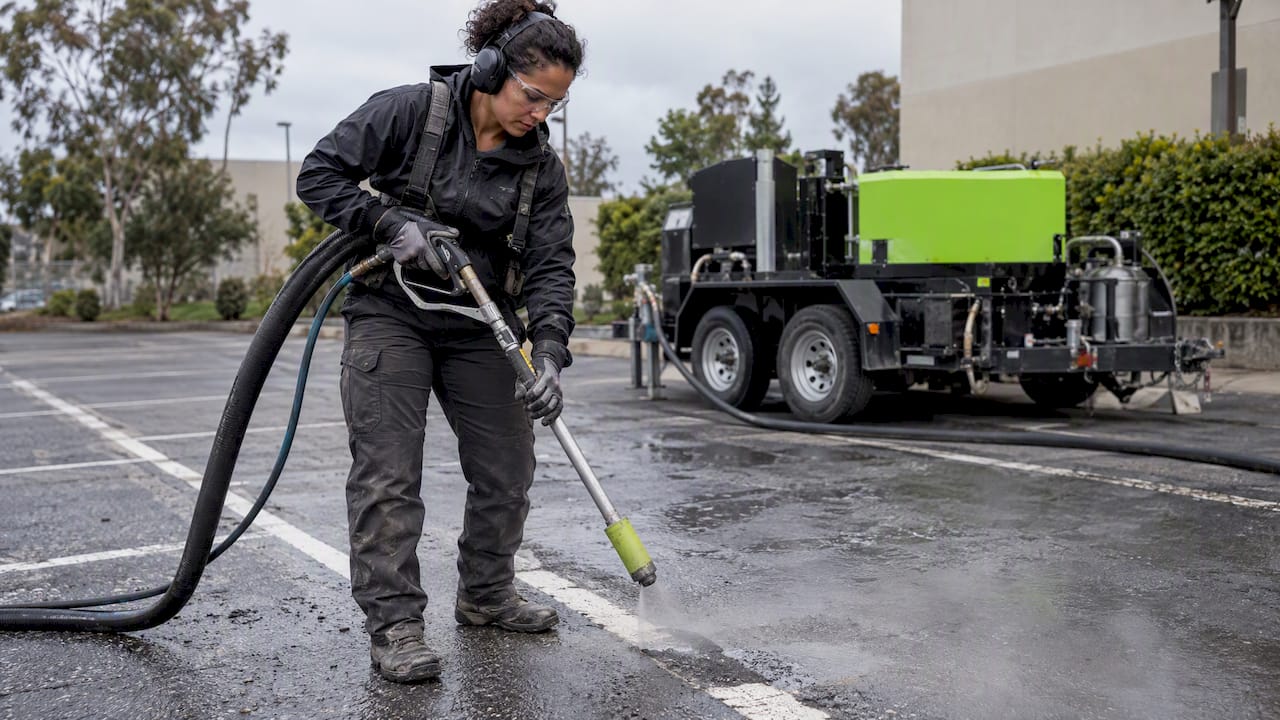
People call asking for "sandblasting" when they mean "get this coating off." The right tool depends on what the coating is, what it's on, and where it is. Here is how the three common methods compare on the jobs we actually see.
The three methods in one paragraph each
Pressure washing pushes water at 2,000–4,000 psi. It removes dirt, mildew, loose paint and chalking. It does not remove paint that is still bonded, rust that is pitted in, or any coating designed to stick. It's the right first step for cleaning and the wrong tool for stripping.
Dry sandblasting fires an abrasive — rarely actual sand anymore; usually crushed glass, coal slag, garnet or steel grit — through compressed air. It strips fast and cuts a profile into steel. It also produces a dust cloud, generates friction heat that can warp thin sheet metal, and is restricted or needs full containment in most Bay Area cities.
Dustless (wet abrasive) blasting puts the abrasive and water together in the pot so each particle leaves the nozzle wrapped in water. You get the stripping power of dry blasting with roughly 90% less airborne dust, no friction heat, and a surface that is rinsed as it's blasted. It's what we run.
Head to head
| Pressure washing | Dry sandblasting | Dustless blasting | |
|---|---|---|---|
| Removes bonded paint | No | Yes | Yes |
| Removes rust / mill scale | No | Yes | Yes |
| Airborne dust | None | Heavy | Low |
| Heat / warping risk on thin metal | None | Yes | Minimal |
| Works on brick & soft masonry | Cleaning only | Risky | Yes, with soft media & low pressure |
| Works on wood | Cleaning only | Usually too aggressive | Case by case, soft media |
| Flash rust on steel | N/A | Slower | Controlled with rust inhibitor |
| Containment needed near people | No | Yes | Usually not |
| Typical Bay Area cost | $0.25–0.75/sq ft | $3–5/sq ft + containment | From $3/sq ft |
Where each one wins
Use pressure washing when the goal is clean, not bare: decks before re-staining, mildew on stucco, dirt on concrete, loose chalky paint before a repaint with a bonding primer.
Use dry blasting when you're in an open yard or a blast booth, the substrate is heavy steel, and you need a deep anchor profile fast — think structural steel at a fabricator. For most field work in the Bay Area the dust restrictions make it impractical.
Use dustless blasting for almost everything in between: painted concrete floors and walls, steel railings and gates in place, trailers and equipment at your yard, graffiti on block, stripe removal on asphalt, prep for epoxy or powder coat, and any job near occupied buildings. Because the rig carries its own water and power, it works anywhere a truck can park.
Two things dustless blasting doesn't fix
It isn't magic on brick under silicone paint — that coating can't come off without destroying the brick face by any method, and we'll tell you so. And on wood, if the only media aggressive enough to lift the finish will also chew the grain, blasting is the wrong answer; sanding or chemical stripping is.
Flash rust, briefly
Bare steel in Bay Area humidity starts to flash-rust within hours whether it was blasted wet or dry. We add a rust inhibitor to the water so the surface holds for roughly 72 hours — enough to get a primer on. If your painter can't make that window, tell us and we'll sequence the work differently.
Bottom line
If the coating is failing, pressure wash. If it's bonded and on steel, concrete, brick or masonry, dustless blasting removes it without the dust, the heat or the containment of dry blasting — and at a comparable price. Call us with the surface, the square footage and what's on it; most jobs are priced over the phone the same day.