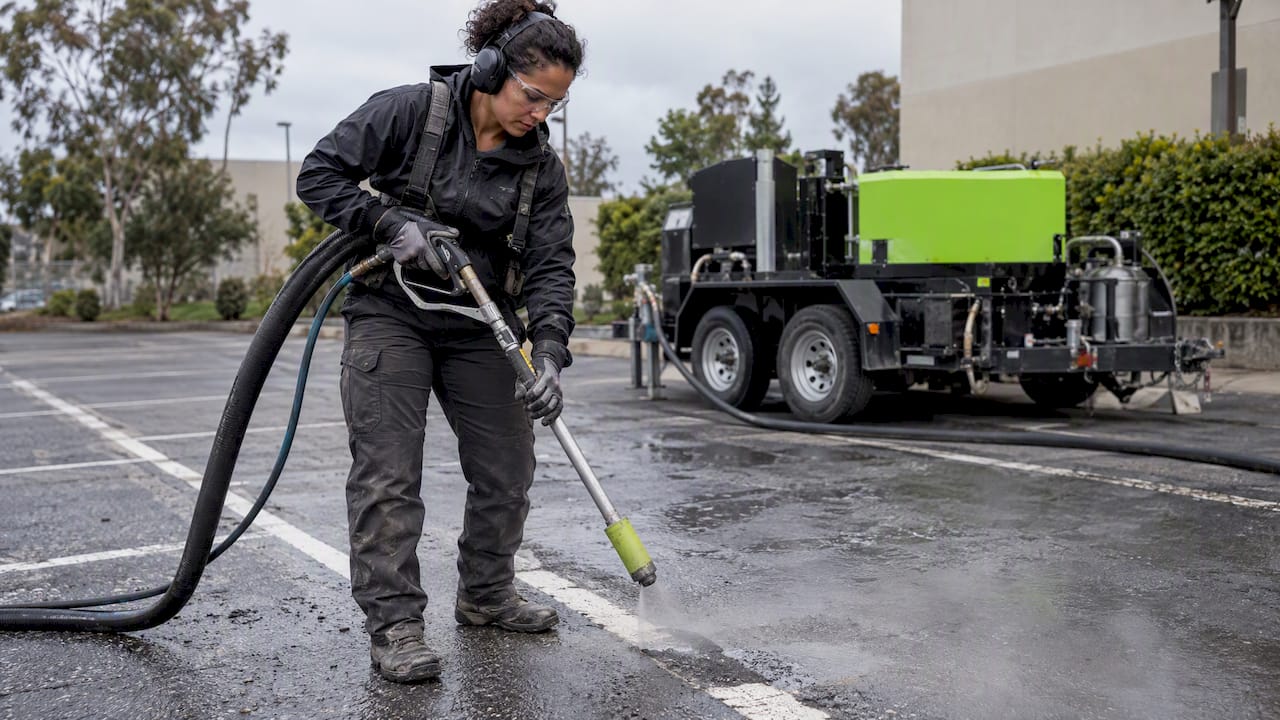
We polish concrete. We also tell a lot of people not to — because grind & seal gets them where they need to be for less. Here's how we think about the three floor options and which one fits which space.
What each one actually is
Grind & seal. We grind the slab with 30–80 grit diamonds to remove coatings, adhesive, high spots and contamination, fill cracks, then apply a clear acrylic or urethane sealer. The look is "clean, uniform concrete" with a satin or gloss topcoat. From $2/sq ft.
Polished concrete. Same start, but the grinding continues through progressively finer diamonds — 100, 200, 400, 800, 1500, sometimes 3000 grit — with a lithium densifier applied partway through that chemically hardens the surface. There is no topical coating; the shine is the concrete itself. Stain guard goes on at the end. Quoted per project; it's 1.5–3× the cost of grind & seal depending on the sheen and how much aggregate you want exposed.
Epoxy (and polyaspartic/urethane) coatings. A film — typically 10–30 mils — bonded to a ground slab. Comes in solid colors, flake and metallic. The prep is our part (CSP 2–3 profile); the coating is applied by a coating contractor. Installed cost in the Bay Area runs $4–9/sq ft for quality systems.
Side by side
| Grind & seal | Polished concrete | Epoxy / polyaspartic | |
|---|---|---|---|
| Cost (installed) | From $2/sq ft | Mid–high | $4–9/sq ft |
| Look | Clean concrete, satin/gloss sealer | Stone-like sheen, matte to mirror | Solid color, flake, metallic |
| Can it peel? | Sealer can wear, re-coat every 2–5 yrs | No — nothing to peel | Yes, if prep or moisture is wrong |
| Hot-tire pickup (garages) | Possible with acrylic; use urethane | No | Possible with cheap epoxy |
| Moisture vapor tolerance | Good | Excellent | Poor without a vapor barrier primer |
| Chemical resistance | Fair | Fair–good with stain guard | Excellent |
| Slip when wet | Fair | Fair (add grip in stain guard) | Poor unless grit is broadcast |
| Maintenance | Re-seal periodically | Dust mop, occasional burnish | Clean; recoat when worn |
| Lifespan | 3–7 yrs per seal coat | 20+ yrs | 7–15 yrs |
| Turnaround | 1–2 days | 2–5 days | 2–4 days incl. cure |
Our recommendation by space
Residential garage. Grind & seal with a urethane sealer for most people. It handles hot tires, resists oil, looks finished, and costs a fraction of epoxy. Choose epoxy/polyaspartic if you want a color or flake look. Full polish is overkill in a garage unless the garage is also a showroom.
Warehouse / distribution. Polished concrete, every time, if the slab is sound. Forklift traffic destroys coatings at the wheel paths; polished concrete has nothing to destroy. The densifier also cuts dusting, which facility managers notice within a week.
Retail, showroom, restaurant dining room. Polished concrete for the look and the maintenance profile. Pick the exposure (cream, salt-and-pepper, or full aggregate) and sheen with a test panel.
Commercial kitchen, brewery floor, auto shop. Epoxy or urethane cement. You need chemical resistance and a coved, seamless surface. We do the prep; the coating contractor does the rest.
Basement, workshop, patio. Grind & seal. Moisture coming up through the slab is common in Bay Area basements and older patios, and a breathable sealer tolerates it where an epoxy film will blister.
The slab decides more than you do
Before we recommend anything we look at the slab: cracks, patches, old adhesive, moisture, how much aggregate is near the surface, whether it was steel-troweled. A slab that's been patched six times will never polish evenly; it will grind & seal fine. A new, hard-troweled warehouse pour is a polishing candidate. An old garage slab with a mastic layer needs the mastic tested before anyone grinds it.
Warranty
We warrant polished and sealed floors for 1–2 years against delamination and polishing defects. Epoxy warranties come from the coating contractor and depend on the system.
Not sure which one you need? Send a photo and the square footage to (628) 222-4876 and we'll tell you — including when the answer is the cheaper option.