Rust Removal Blasting in California: Methods, Rules and Cost
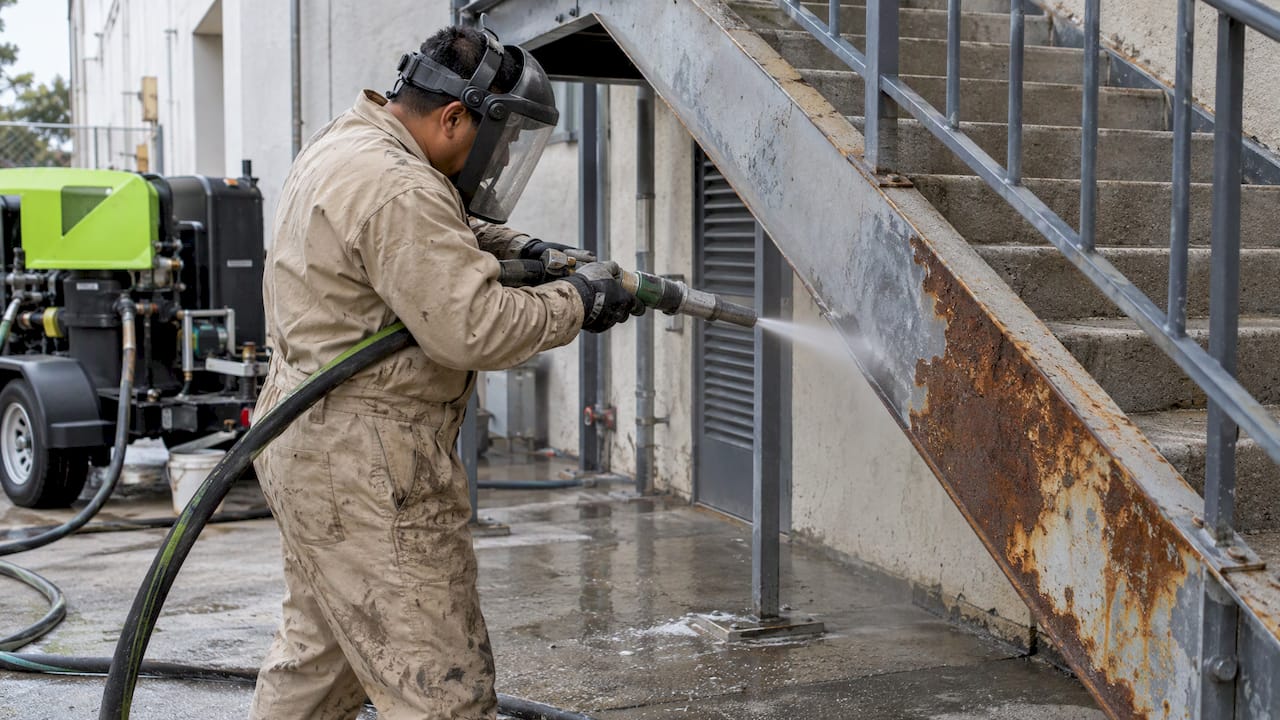
Blasting removes rust, but the method decides what you get back: clean, profiled steel ready for coating, or pitted metal and a dust problem. In California, wet (dustless) blasting is usually the practical choice for rust on gates, rails, tanks, structural steel and equipment, because it cuts dust and fits the state’s rules on outdoor blasting. We run mobile dustless rigs across San Francisco and the Bay Area, with rust and metal blasting priced from $3 per sq ft.
This guide is for contractors, property managers, homeowners and facility managers who need rusted steel prepared properly. It covers how blasting works, how to choose a method, what California requires, what it costs and what has to happen in the hours after the rust is gone.
TL;DR
- Abrasive blasting propels media at a surface with compressed air or water. It strips rust and leaves a textured profile that coatings grip.
- Wet (dustless) blasting suits most rust jobs on site. Our rigs produce up to 92% less dust than traditional dry sandblasting.
- California generally requires abrasive blasting inside a permanent building. Wet blasting is one of the listed outdoor exceptions for large or permanently installed items.
- Our rust and metal blasting starts at $3 per sq ft. Surface preparation to coating spec runs $2 to $3 per sq ft.
- Freshly blasted steel can flash rust within hours or days, so coating timing is part of the job, not an afterthought.
Table of Contents
- How blasting removes rust
- Dry blasting, wet blasting and what the difference means on site
- Match the method to the rust and the metal
- California rules on blasting rust
- Dust control and cleanup
- What rust blasting costs
- Protecting the steel after the rust is gone
- What a rust blasting job looks like with us
- Get an estimate for your rusted steel
- Our view: prepare for the coating, not just for the rust
- FAQ
- Sources
How blasting removes rust
OSHA defines abrasive blasting as propelling abrasive at high velocity with compressed air or water to clean surfaces, remove burrs, apply texture or prepare a surface for coating. For rust, that means the media physically knocks off the oxide layer, mill scale and old coating, and exposes bare metal.
The texture it leaves matters as much as the rust it takes off. Paint and protective coatings bond to a roughened surface far better than to smooth steel. That roughness is called the surface profile, and coating manufacturers specify how much they need. When we prepare steel for a coating, we work to the spec the coating calls for.
A typical preparation sequence, as described in Hempel’s U.S. technical guidance, has three stages:
- Liquid cleaning to remove oil, grease, salts and debris.
- Abrasive blasting to remove rust and create profile.
- Final cleaning to remove dust and residue before the coating goes on.
Skipping the first stage is a common reason rust returns early. Salts and oils left on the steel get sealed under the new coating.
Dry blasting, wet blasting and what the difference means on site
The two main families are dry air blasting and wet abrasive blasting. Hempel lists compressed-air, centrifugal-wheel, vacuum, slurry and pressurized-liquid variants within those two groups.
For a property manager or homeowner, the practical differences are these:
| Traditional dry sandblasting | Wet (dustless) blasting | |
|---|---|---|
| Dust | Heavy airborne dust from media and the surface | Up to 92% less dust with our method |
| Containment | Usually needs an enclosure | Easier to run around occupied buildings |
| Cleanup | Dry media spreads widely | Wet cleanup is simpler to control |
| Best for | Shop work inside a booth | On-site rust on gates, rails, tanks, equipment, structural steel |
OSHA’s maritime guidance names wet abrasive blasting and hydroblasting among the alternatives that can reduce or eliminate the dust of dry blasting. That is the reason we built our service around the wet method.
If you want a side-by-side of what each method removes, our comparison of dustless blasting, sandblasting and pressure washing goes through it by surface.
Match the method to the rust and the metal
Not all rust is the same job. Light surface rust on a railing is a different problem from scale on structural steel or pitting on a machined part. Our page on steel rust removal by rust depth walks through the levels.
Media choice also matters. OSHA lists silica sand, coal slag, garnet, nickel slag, copper slag, glass, steel shot, steel grit and specular hematite as common media, and ice, dry ice, plastic beads, sponge, baking soda, walnut shells and corn cob as less-toxic alternatives. NIOSH has recommended since 1974 that silica sand be prohibited as a blasting material, with less hazardous substitutes used instead.
The finish depends on the media and the metal. The Canadian Conservation Institute notes that sand blasting can severely pit metal, while glass beads leave a matte or satin finish that is unwelcome on machined surfaces. Excessive polishing can also change dimensions and remove original wear marks. So tell your contractor if the part is machined, decorative or historic. Fit-critical surfaces and ornamental ironwork need a gentler approach than a structural beam.
Tell us the following when you request an estimate, and the right approach gets easier to pick:
- What the item is and the metal (steel, cast iron, aluminum).
- How deep the rust goes: surface bloom, scaling or pitting.
- Whether it has old paint, and whether that paint may contain lead.
- What goes on afterward: paint, powder coating or a sealer.
If powder coating is the next step, see our prep for powder coating page.
California rules on blasting rust
A common search is whether sandblasting is illegal in California. It is not banned, but it is regulated, and the rules shape how a job is done.
Air quality. The California Air Resources Board generally requires abrasive blasting inside a permanent building. Outdoor exceptions include blasting with exclusively steel or iron shot or grit, or with certified abrasives, and wet, hydroblasting or vacuum blasting when the item is larger than 8 feet in any dimension or is at its permanent location. Permissible outdoor blasting is held to a 20% opacity visible-emission standard. A fence, a tank, a staircase bolted to a building or a steel frame usually falls into the large or fixed category. If you are unsure whether your item qualifies, ask us before you book anyone.
Worker protection. Title 8, section 5151 of the California Code of Regulations, covers blasting enclosures, inward airflow and dust removal before an enclosure is opened. It also requires abrasive-blasting or equivalent respirators inside blasting rooms and during continuous blasting where dust may exceed exposure limits, with eye and face protection as specified.
Silica. If the media or the surface contains crystalline silica, OSHA’s standard applies. Per VestMed’s compliance guide, it sets a permissible exposure limit of 50 micrograms per cubic meter as an 8-hour average, with an action level of 25. Concrete and masonry contain silica, which matters when rusted steel is embedded in or attached to them.

Lead paint. Old paint on steel can contain lead. Cal/OSHA’s construction guidance says employers must assess exposure for employees who may do dry abrasive blasting. It also sets the lead permissible exposure limit at 25 micrograms per cubic meter until January 1, 2030, and 10 after that date. If your structure predates the 1978 lead-paint ban or you do not know the paint history, say so when you ask for a quote. We offer lead paint removal, and the paint history is the first thing we want to know.
Dust control and cleanup
The dust from blasting comes from both the media and what is being removed. OSHA’s guidance recommends wet cleaning or HEPA vacuuming and prohibits compressed-air cleanup because it puts settled dust back into the air. It also advises cleaning contaminated tarps and equipment, avoiding windy conditions and scheduling work when fewer people are present.
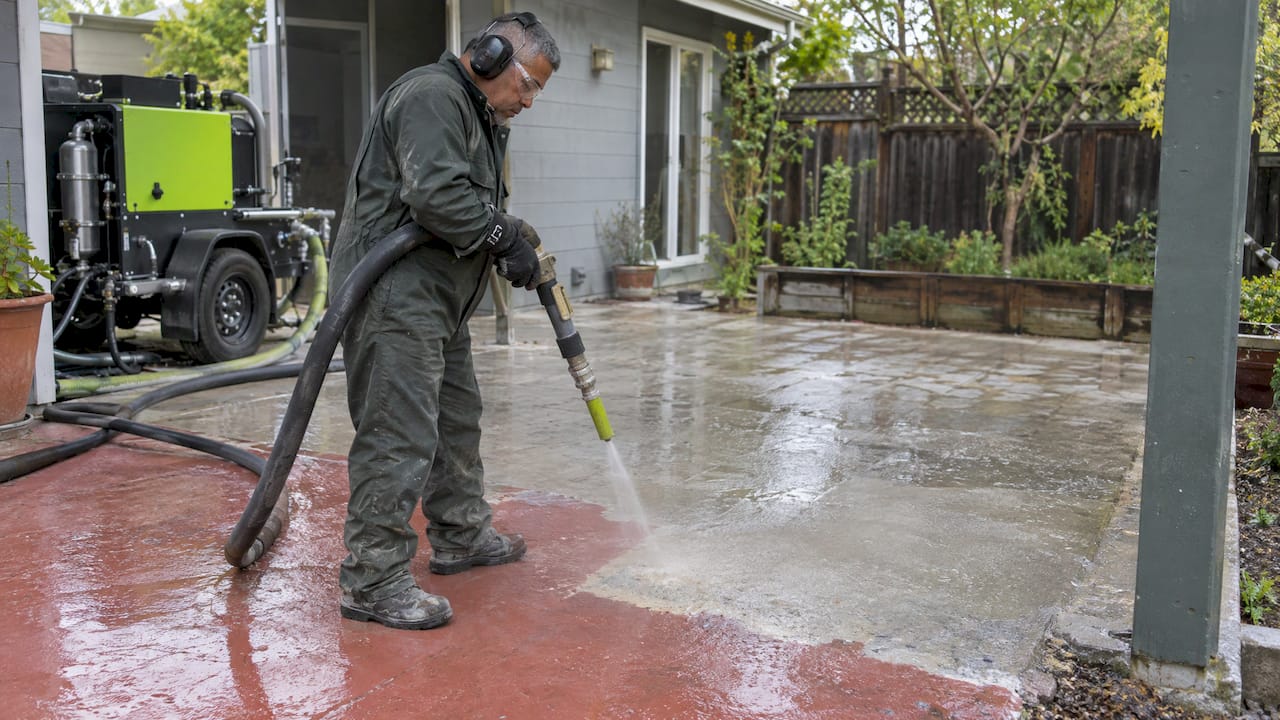
For a property manager, that last point is practical. Ask for blasting to be scheduled around tenant hours, loading times and school or street activity. Our rigs are self-contained, carrying their own air and power, so a job needs parking and access to the surface rather than on-site utilities, which makes scheduling around a building’s routine easier.
What rust blasting costs
National figures give a frame. Bob Vila reports a U.S. sandblasting range of $437 to $1,656, with a $1,000 average, and commonly $1 to $5 per square foot, as of December 2023. Area, surface type, method, media, labor and add-ons all move the price, and wet, dry, dustless, hydro and dry-ice methods sit at different levels.
Our published pricing, per square foot, is:
| Service | Price |
|---|---|
| Rust and metal blasting | from $3 per sq ft |
| Dustless blasting | from $3 per sq ft |
| Paint removal | from $3 per sq ft |
| Surface preparation to coating spec | $2 to $3 per sq ft |
| Concrete grinding and grind and seal | from $2 per sq ft |
These are starting prices, and the final quote depends on the item and the condition of the steel. For a full breakdown of what moves the number, see our Bay Area dustless blasting cost guide.
Worked example. A 200 sq ft run of rusted steel fencing at the $3 starting rate comes to $600 before any adjustments for rust depth or access. Add a coating-ready surface prep and the quote reflects that scope. The way to sanity-check any quote is to ask what is included: rust and old coating removal, cleanup, the surface profile and the timing of the coating.
Protecting the steel after the rust is gone
This is the step most people underestimate. Bare blasted steel is highly reactive. Flash rust can appear quickly, and the speed depends on humidity, temperature and any salts left on the surface.
Two documented ways to buy time:
- Rinse and inhibit. HoldTight 102, per its product data sheet, prevents flash rust for approximately 48 hours, often longer with no rain and temperatures above 40°F, and removes surface salts including chlorides, sulfates and nitrates.
- Passivate. KTA-Tator describes surface passivators that slow the onset of rust for up to 72 hours depending on the environment. These are not removed before coating, so the coating manufacturer must confirm compatibility, and the treated area must be protected from rain, immersion, splash and heavy condensation.
Hempel’s guidance adds a point specific to wet work: the water should be fresh and low in salt, and slurry should be rinsed off immediately rather than allowed to dry.
The simplest plan is to line up the coating before the blasting. Decide the primer, confirm the profile it needs, and book the painter or powder coater for the days right after the work. Contractors on larger jobs should put the coating window into the schedule the same way they put in the blasting date.
What a rust blasting job looks like with us
- Estimate. Send photos, dimensions and the location. Estimates are free, and we schedule quickly.
- Site visit and spec. We look at the rust depth, the metal and the coating that follows, so the surface prep matches what the coating needs.
- Setup. The rig arrives self-contained with its own air and power. We need parking and access to the surface.
- Blasting and cleanup. Rust and old coatings come off with up to 92% less dust than dry sandblasting.
- Handoff to coating. The steel is ready for primer or powder coating, and the timing is planned around the flash-rust window above.
Our rust removal and steel blasting page lists what we handle, and our surface preparation service covers work to a coating specification.
Get an estimate for your rusted steel
We prepare steel across San Francisco, the Peninsula, the East Bay, the South Bay and Northern California. Rust and metal blasting starts at $3 per sq ft, and estimates are free. Send us the item, the size and what goes on afterward, and we will tell you how we would handle it.

See all our services and prices, or call us at 628-222-4876 for a quick site visit.
Our view: prepare for the coating, not just for the rust
Most failed rust jobs fail on the same three points: rust left in pits, salts left on the steel, and a gap between blasting and coating. None of them is about how aggressive the blasting was.
That is why we run wet. Dustless blasting lets us work around occupied buildings, on rails, gates, tanks and equipment that cannot move to a shop, with up to 92% less dust than traditional dry sandblasting. The rigs carry their own air and power, so the job needs only parking and access to the surface.
We quote per square foot and say what the price covers. Rust and metal blasting starts at $3 per sq ft, surface prep to coating spec is $2 to $3, and the estimate is free. For contractors, we work to the coating spec on the drawings. For homeowners and property managers, we plan around when you can coat.
If you are weighing a quote from anyone, ask what profile they are working to and when the coating goes on. We are glad to answer both for your job.
USA
FAQ
Will sandblasting remove rust?
Yes. Abrasive blasting strips rust, scale and old coatings and leaves a textured profile that coatings grip. The method and media decide the finish, since sand can pit metal and softer media suit delicate or machined parts. We use the wet method for on-site rust.
Is sandblasting illegal in California?
No, but it is regulated. CARB generally requires abrasive blasting inside a permanent building, with outdoor exceptions that include wet blasting of items over 8 feet in any dimension or at their permanent location. Worker protection rules in Title 8 apply as well. Tell us about the item and location and we will confirm the approach.
How much does sandblasting cost?
Nationally, Bob Vila reports commonly $1 to $5 per square foot. Our rust and metal blasting starts at $3 per sq ft, and surface prep to coating spec is $2 to $3 per sq ft. The final quote depends on the item and the rust depth.
How soon do I need to coat steel after blasting?
As soon as practical. Flash rust can form quickly on bare steel, and inhibitors or passivators extend the window by roughly 48 to 72 hours in the right conditions. Plan the coating before the blasting date.
Can I do rust blasting myself?
Small, occasional jobs with suitable equipment are possible, but large surfaces, repeated cycles and delicate parts call for a professional. Dust control, respiratory protection and lead or silica exposure add real requirements. For a Bay Area property, we can quote it for free.
Sources
- OSHA: Protecting Workers from the Hazards of Abrasive Blasting
- OSHA Maritime Guidance: Abrasive Blasting Hazards
- Hempel: Surface preparation
- New Jersey Department of Health: silica substitutes
- Canadian Conservation Institute: Mechanical Removal of Rust from Machined Ferrous Surfaces
- California Air Resources Board: Abrasive Blasting Program
- California Code of Regulations, Title 8, Section 5151
- VestMed: OSHA Silica Standard Compliance Guide
- Cal/OSHA: Lead Exposure Prevention in Construction
- Bob Vila: How Much Does Sandblasting Cost?
- HoldTight 102 product data sheet
- KTA-Tator: Preserving the Blast Using Passivators